
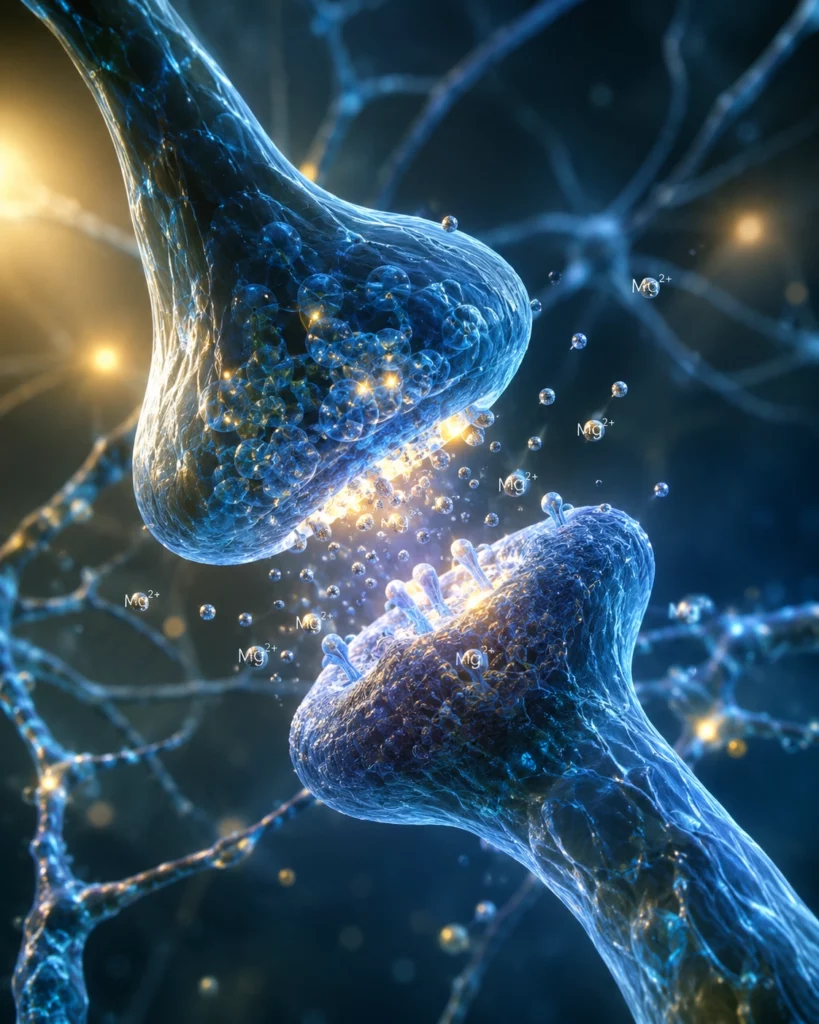
Magnesium is often called the “mineral for the nervous system,” and this is not a marketing ploy. It is involved in the transmission of nerve impulses, regulates the activity of hundreds of enzymes, affects energy production in brain cells, supports normal neuron function, and helps protect them from excessive excitation. That is why a magnesium deficiency can manifest not only as cramps or fatigue but also as anxiety, impaired concentration, memory loss, and sleep problems.
In this article, we will explore why the brain is so dependent on magnesium, which mechanisms have already been scientifically proven, whether magnesium helps with stress, and if it can improve cognitive functions.
What this article is based on
This material was prepared based on the fundamental monograph “Magnesium in the Central Nervous System”, published by University of Adelaide Press, modern review articles from PubMed, recommendations from the NIH Office of Dietary Supplements, and other verified scientific sources. The main mechanisms of magnesium’s action are described in the book by editors Robert Vink and Mihai Nechifor.
What you will learn from this article
- why magnesium is vital for the brain;
- how it participates in the transmission of nerve signals;
- why magnesium deficiency can affect memory;
- what connection exists between magnesium and stress;
- how magnesium affects sleep;
- whether magnesium is capable of protecting neurons;
- who is most likely to lack magnesium.
Why the brain needs magnesium
If you look at the brain under a microscope, you can see billions of neurons exchanging electrical signals every second.
Each of these signals depends on the work of ions.
Sodium triggers the nerve impulse.
Potassium helps to complete it.
Calcium transmits the signal between cells.
And magnesium controls this entire system.
That is why researchers often call it a natural regulator of nerve activity. Without enough magnesium, neurons become more excitable, exhaust faster, and cope worse with loads. These mechanisms are described in detail in the book Magnesium in the Central Nervous System.
Magnesium participates in over 600 biochemical reactions
Just a few decades ago, scientists talked about approximately 300 reactions.
Today, much more is known.
For the brain, the following functions of magnesium are particularly important:
- ATP synthesis, the cell’s main energy source;
- protein synthesis;
- stabilization of cell membranes;
- mitochondrial function;
- regulation of calcium channels;
- synthesis of neurotransmitters;
- transmission of nerve impulses;
- brain plasticity;
- learning processes.
In fact, magnesium is involved in almost every stage of a nerve cell’s work.

How magnesium protects neurons
One of the most interesting discoveries of recent decades concerns NMDA receptors.
These receptors are necessary for learning and memory formation.
But there is one problem.
If they work too actively, an excessive amount of calcium begins to enter the neuron.
A cascade of damage is triggered.
In severe cases, the cell may die.
This is where magnesium comes into play.
At rest, it naturally blocks NMDA receptors, preventing them from becoming over-activated. When the cell truly needs to transmit a signal, this block is temporarily lifted.
In this way, magnesium acts as a natural safety system for the brain. This mechanism is one of the keys in modern neurophysiology.
Table 1. Main functions of magnesium in the nervous system
| Function | Purpose |
|---|---|
| Regulation of NMDA receptors | Protection of neurons from excessive excitation |
| Transmission of nerve impulses | Normal functioning of nerve cells |
| ATP synthesis | Providing the brain with energy |
| Mitochondrial function | Production of cellular energy |
| Neurotransmitter synthesis | Regulation of mood and cognitive functions |
| Brain plasticity | Learning and memory formation |
| Calcium metabolism control | Protecting cells from damage |
| Antioxidant protection | Reduction of oxidative stress |
Why the brain feels magnesium deficiency first
The body strictly maintains magnesium concentration in the blood.
Even if a person receives insufficient magnesium for a long time, a blood test may remain normal.
The reason is simple.
The body begins to pull magnesium from tissues.
First and foremost, the following suffer:
- the nervous system;
- muscles;
- the heart;
- bone tissue.
That is why early symptoms of deficiency are often related specifically to the nervous system.
A person may not yet have a severe deficiency but already notices:
- rapid fatigue;
- irritability;
- difficulty concentrating;
- restless sleep;
- increased reaction to stress.
At this stage, many do not even suspect that the problem may be related to insufficient magnesium intake.
Magnesium and memory
Just 20 years ago, magnesium was considered primarily a mineral for muscles.
Today, the situation is completely different.
Experimental studies have shown that normal magnesium levels are necessary for:
- forming new memories;
- learning;
- long-term memory;
- synaptic plasticity;
- effective interaction between neurons.
Of particular interest was work regarding increasing magnesium concentration specifically in brain tissue. These studies became the basis for further research into different forms of magnesium, specifically magnesium L-threonate.

Magnesium and stress: why the body uses it up faster
Every stressful situation triggers a complex chain of reactions. Adrenaline and cortisol levels rise in the blood, heart rate accelerates, and energy expenditure increases. Along with this, magnesium metabolism also changes.
Studies show an interesting pattern. Stress can increase magnesium loss through urine. Simultaneously, a deficiency of magnesium itself intensifies the body’s reaction to stressors. It creates a kind of vicious circle: stress reduces magnesium reserves, and a lack of magnesium makes the nervous system even more sensitive to stress. This relationship is described in detail in the chapters of the book dedicated to magnesium neurophysiology.
That is why after prolonged emotional strain, people often complain of:
- constant fatigue;
- irritability;
- difficulty falling asleep;
- headaches;
- decreased concentration.
Of course, these symptoms do not automatically mean a magnesium deficiency. They can have dozens of causes. However, the role of magnesium in the adaptation of the nervous system is well-studied today.
Magnesium and anxiety
A question often asked at the pharmacy:
“Does magnesium help with nerves?”
The answer is a bit more complex than just “yes” or “no.”
Magnesium is not a sedative. It does not work like a sleeping pill or a tranquilizer.
Its action is much more subtle.
The mineral participates in systems that regulate the balance between excitation and inhibition processes in the central nervous system. It also affects the activity of receptors through which GABA, glutamate, and other neurotransmitters operate.
That is why with insufficient magnesium intake, the nervous system may react much more sharply to ordinary stimuli.
Modern clinical studies show that in certain groups of people with insufficient magnesium supply, its correction can be accompanied by an improvement in subjective well-being, a reduction in the feeling of tension, and an improvement in quality of life. At the same time, magnesium cannot be considered a universal cure for anxiety disorders.
Magnesium and sleep
Poor sleep is often linked to melatonin.
In reality, normal sleep depends on dozens of biochemical processes.
Magnesium participates in many of them.
It is necessary for:
- normal nerve cell function;
- regulation of circadian rhythms;
- transmission of nerve signals;
- GABA receptor function;
- supporting physiological muscle relaxation.
This is why, with insufficient magnesium supply, some people may experience difficulty falling asleep or shallow sleep.
At the same time, it is important to understand the difference.
If insomnia is caused by, for example, obstructive sleep apnea, severe depression, or other diseases, magnesium alone will not solve the problem.
Magnesium and memory: what is known today
One of the most fascinating topics in modern neurobiology is related to brain plasticity.
It was previously believed that memory only depended on the number of neurons.
Today we know that the connections between them are much more important.
These contacts are called synapses.
It is in them that new neural networks are constantly formed when a person learns, remembers information, or gains new experience.
Magnesium participates in processes that ensure such plasticity.
In the book, separate chapters are dedicated to how magnesium concentration in brain tissue affects long-term potentiation, one of the key mechanisms of learning and memory.
This is why, in recent years, forms of magnesium capable of more effectively penetrating the blood-brain barrier have been actively researched.
Table 2. How magnesium affects various brain functions
| Function | Potential role of magnesium |
|---|---|
| Memory | Participation in the formation of new synapses |
| Concentration | Support of normal nerve impulse transmission |
| Sleep | Participation in the regulation of nerve activity |
| Stress | Regulation of the body’s response to loads |
| Mood | Effect on neurotransmitter function |
| Neuron protection | Control of excessive calcium intake |
| Energy metabolism | Participation in ATP synthesis |
| Brain aging | A possible neuroprotective effect is being researched |
Who should especially watch their magnesium levels
An increased risk of insufficient magnesium intake is found in:
- elderly people;
- pregnant women;
- athletes;
- people with an imbalanced diet;
- patients with certain gastrointestinal diseases;
- people taking certain medications for a long time that may affect magnesium metabolism.
That is why risks must be assessed comprehensively, and not just based on the results of a single blood test.

Myths and facts
Myth: Magnesium is only needed for muscles.
Fact: The nervous system is one of the largest consumers of magnesium.
Myth: If a blood test is normal, there can be no deficiency.
Fact: Serum magnesium levels do not always reflect total body stores.
Myth: The more magnesium, the better the brain works.
Fact: Excessive magnesium is also undesirable. The body requires physiological balance.
Frequently Asked Questions
Can memory be improved only with the help of magnesium?
No. Memory depends on many factors: sleep, physical activity, nutrition, learning, age, and overall health. Magnesium is only one component of this complex system.
Which foods contain the most magnesium?
Pumpkin seeds, almonds, cashews, cocoa, beans, spinach, buckwheat, whole grain products. These foods are rich not only in magnesium but also in fiber, which is critically important for gut health. And since the gut and brain are closely connected, this is a double benefit for the body.
Does everyone need to take magnesium supplements?
No. For many people, a balanced diet is sufficient. The need for additional intake is determined individually.
Why is magnesium called a natural brain protector?
Because it participates in the regulation of NMDA receptors and helps limit excessive excitation of neurons, which can damage nerve cells.
Conclusions
Magnesium is one of the key minerals for the functioning of the central nervous system. It participates in energy production, transmission of nerve impulses, maintenance of brain plasticity, and regulation of neuron activity.
Modern research confirms its important role in normal brain functioning. At the same time, magnesium is not a universal remedy for all neurological or psycho-emotional problems. The best result is provided by a comprehensive approach: balanced nutrition, adequate sleep, physical activity, and timely identification of possible causes of deficiency.
References
- Robert Vink, Mihai Nechifor (Editors). Magnesium in the Central Nervous System. University of Adelaide Press, 2011.
- National Institutes of Health. Office of Dietary Supplements. Magnesium Fact Sheet for Health Professionals.
- EFSA Panel on Nutrition, Novel Foods and Food Allergens. Scientific Opinions on Dietary Reference Values for Magnesium.
- Gröber U, Schmidt J, Kisters K. Magnesium in Prevention and Therapy. Nutrients.
- de Baaij JHF, Hoenderop JGJ, Bindels RJM. Magnesium in Man: Implications for Health and Disease. Physiological Reviews.
About the Author