
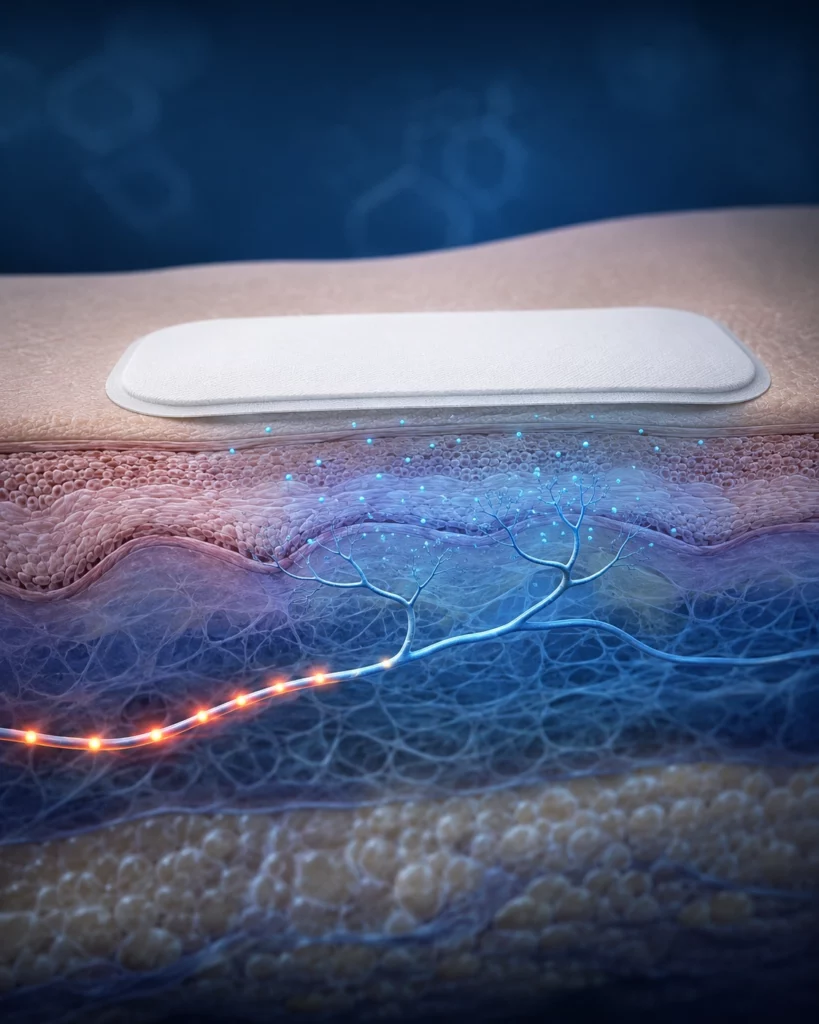
Scientific-educational review | For general practitioners, neurologists, orthopedists, pharmacists
Pain is one of the most common reasons for seeking medical care worldwide. Systemic pharmacotherapy — NSAIDs, opioids, anticonvulsants — is effective but associated with a significant risk of adverse systemic effects: gastrointestinal, cardiovascular, and neurocognitive. This is why interest in topical forms of analgesics has significantly increased over the past two decades — international guidelines classify them as first- or second-line therapy for chronic pain. [5]
Among topical agents, lidocaine holds a special place — an amide-type local anesthetic that, when applied transdermally in the form of a patch, provides a topical analgesic effect without a complete sensory block. This is the fundamental difference between the transdermal form and injectable lidocaine: the concentration of the active substance in the tissues is insufficient for anesthesia but sufficient to suppress nociceptive signals. In the 1990s, the FDA approved the 4–5% transdermal form of lidocaine, and since then, the clinical evidence base has expanded significantly. [5]

Mechanism of Action of Lidocaine in Topical Application
Blockade of Voltage-Gated Sodium Channels
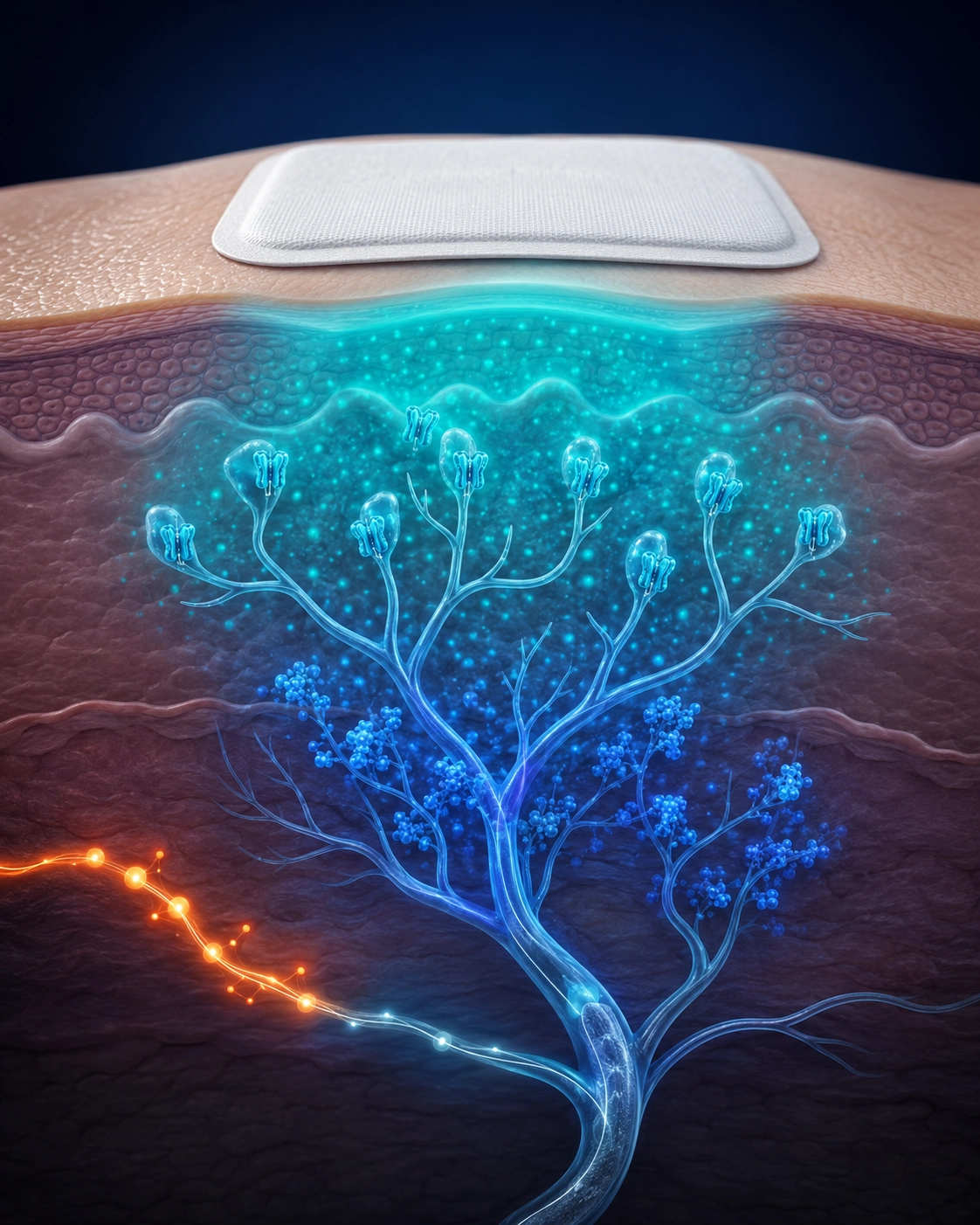
Lidocaine is an amide-type local anesthetic. According to its pharmacodynamics, it is a non-selective blocker of voltage-gated sodium channels, particularly subtypes expressed on small-diameter sensory afferent neurons involved in nociception. [5,11]
Lidocaine binds to sodium channels in the open or inactivated state and stabilizes neuronal membranes, preventing their depolarization. This leads to:
- reduction of ectopic discharges in damaged or pathologically excited nociceptive fibers;
- suppression of the generation and conduction of pain impulses in Aδ and C fibers;
- topical analgesic effect without a complete sensory block — the patient retains tactile and thermal sensitivity. [5]
Important: “the penetration of lidocaine into the skin produces an analgesic effect without producing a complete sensory block” — Gudin & Nalamachu, Postgrad Med. 2020. [5] Therefore, in the clinical context of the patch, it is correct to use the term topical analgesic effect rather than “anesthesia.”
In topical application, lidocaine acts at the level of peripheral nociceptors — at the site of pain — without reaching the central nervous system in clinically significant concentrations. [5]
Effect on TRPV1 and TRPA1 Receptors
In addition to sodium channel blockade, according to preclinical studies (rodent models and cell cultures), lidocaine in high concentrations can additionally activate TRPV1 and, to a lesser extent, TRPA1 receptors on sensory neurons, causing the release of the neuropeptide CGRP. This mechanism, observed in experimental conditions, may explain transient burning sensations during application and requires confirmation in human clinical trials. [12]
Why the Topical Form Minimizes Systemic Effects
When applied to the skin, lidocaine is absorbed slowly and limitedly through intact skin. The plasma concentration remains significantly below the threshold for systemic effects. This fundamentally distinguishes transdermal application from injection: effective local analgesia without the risk of cardio- and neurotoxicity. [5]
Pharmacokinetics of Topical Lidocaine
| Protein Binding | Mainly to plasma α-1-acid glycoprotein |
| Metabolism | In the liver → inactive metabolites |
| Excretion | By the kidneys |
| Elimination T½ | ~7.6 hours |
| Patch Duration of Action | 8–12 hours |
| Dose Adjustment | Generally not required in renal/hepatic impairment |
Due to minimal systemic absorption, the risk of drug-drug interactions in transdermal application is clinically insignificant. [5]
Menthol as a Co-agent in Combined Forms
Mechanism of Action of Menthol: Activation of TRPM8 Channels
Menthol is a selective agonist of TRPM8 channels — the skin’s cold receptors. Activation of TRPM8 causes a sensation of coolness, followed by desensitization of nociceptors (counter-irritant effect). Menthol is also a vasoactive compound, and there are reasons to believe it may activate central analgesic pathways in topical application. [4]
Clinical Data on Combination Efficacy
In a randomized, double-blind study by Castro and Dent (2017), a combined patch (lidocaine 3.6% + menthol 1.25%) was non-inferior to prescription lidocaine 5%, outperforming placebo in pain relief and quality of daily activity scores. [3] The authors hypothesized that menthol might enhance the transdermal delivery of lidocaine by increasing skin permeability; however, this explanation is an assumption by the study authors rather than a proven mechanism.
Note: The exact mechanism of interaction between menthol and lidocaine in combined patches requires further study in specialized skin permeability research. Available clinical data confirm the efficacy of the combination but do not allow for a final differentiation of each component’s contribution.
Clinical Efficacy Data
Post-herpetic Neuralgia (PHN)
Review by Gudin and Nalamachu (2020): 5% lidocaine patches are effective and well-tolerated in PHN with minimal risk of toxicity. Application is supported by AAN, EFNS, and Canadian Pain Society guidelines as first-line therapy for neuropathic pain. [5]
RCT by Wang et al. (2023), n=240 patients with PHN: average reduction in pain on the VAS at week 4 — 14.01 points (lidocaine) vs 9.36 points (placebo), p=0.009. The safety profile was comparable between groups. [8]
Trigeminal Neuralgia (PATCH trial, 2024)
Multicenter, double-blind RCT (Zhao et al., 2024): therapeutic failures 26% (lidocaine) vs 58% (placebo), relative risk 0.48 (95% CI 0.31–0.75), p<0.001. The time to loss of therapeutic response was significantly longer in the lidocaine group (HR 0.275, p<0.001). No serious systemic adverse events were recorded. [10]
Myofascial Pain Syndrome and Back Pain
Firmani et al. (2015), n=36: 5% lidocaine patch significantly reduced spontaneous pain and increased the pressure pain threshold in myofascial trigger points compared to placebo. [2] Liggieri and Minson (2023), in a case series (n=3), described positive results in post-traumatic localized neuropathic pain in both monotherapy and complex treatment; data are based on individual case descriptions and require confirmation in controlled studies. [9]
Safety Profile
Local Skin Reactions
The most common adverse events are local reactions at the application site (mostly mild or moderate): [6,8]
- Erythema at the application site — the most frequent reaction, mostly mild and transient;
- Edema at the application site — occurs less frequently than erythema;
- Pruritus, papules, vesicles — occur less frequently. Exact frequency rates of these reactions vary depending on the study and specific dosage form; for reliable figures, refer to the drug’s prescribing information and primary sources.
Contact Allergy
Occurs less frequently than with benzocaine. According to To et al. (2014), lidocaine is the second most common allergen among local anesthetics (32% vs. 45% for benzocaine). The mechanism is a delayed Type IV hypersensitivity reaction (local contact dermatitis). The risk of systemic anaphylaxis is extremely low. [1]
Systemic Effects and Post-marketing Surveillance Data
Systemic absorption of lidocaine in transdermal application is minimal. An open-label prospective study of long-term (up to 4 years) use of 5% lidocaine patches in patients with PHN did not reveal clinically significant systemic side effects or signs of cumulative toxicity with repeated long-term use. [7] In a separate randomized study compared with oral pregabalin, the frequency of treatment-related adverse events was significantly lower with the lidocaine patch: 5.8% vs. 41.2%, p<0.0001. [13]
Contraindications and Precautions:
| Absolute | Hypersensitivity to lidocaine or patch components; damaged/infected skin at the application site; children under 12 years old |
| Precautions | Pregnancy, lactation; severe renal/hepatic impairment |
| Action upon AE | If a rash, severe itching, or worsening of skin condition occurs — remove the patch and consult a doctor |
Conclusion
Lidocaine is an amide-type local anesthetic that, when applied transdermally in the form of a patch, provides a topical analgesic effect without a complete sensory block. The mechanism is related to the blockade of voltage-gated sodium channels and stabilization of the membranes of peripheral nociceptors. [5]
The combination of lidocaine with menthol demonstrates clinical efficacy comparable to higher-concentration prescription forms. The exact mechanism of this synergism requires further study. [3,4]
The safety profile of transdermal lidocaine is favorable — significantly better compared to systemic agents. Its use is supported by international guidelines (AAN, EFNS, Canadian Pain Society) for neuropathic pain. [5]
Clinical Conclusion: Transdermal lidocaine can be considered as part of a multimodal approach to treating localized acute and chronic pain in adults and children from 12 years of age.
References
- To D, Kossintseva I, de Gannes G. Lidocaine contact allergy is becoming more prevalent. Dermatol Surg. 2014;40(12):1367–72. DOI: 10.1097/DSS.0000000000000190
- Firmani M, Miralles R, Casassus R. Effect of lidocaine patches on upper trapezius EMG activity and pain intensity in patients with myofascial trigger points. Acta Odontol Scand. 2015;73(3):210–8. DOI: 10.3109/00016357.2014.982704
- Castro E, Dent D. A comparison of transdermal OTC lidocaine 3.6% menthol 1.25%, Rx lidocaine 5% and placebo for back pain and arthritis. Pain Manag. 2017;7(6):489–498. DOI: 10.2217/pmt-2017-0029
- Pergolizzi JV Jr et al. The role and mechanism of action of menthol in topical analgesic products. J Clin Pharm Ther. 2018;43(3):313–319. DOI: 10.1111/jcpt.12679
- Gudin J, Nalamachu S. Utility of lidocaine as a topical analgesic and improvements in patch delivery systems. Postgrad Med. 2020;132(1):28–36. DOI: 10.1080/00325481.2019.1702296
- Santana JA, Klass S, Felix ER. The Efficacy, Effectiveness and Safety of 5% Transdermal Lidocaine Patch for Chronic Low Back Pain. PM R. 2020;12(12):1260–1267. DOI: 10.1002/pmrj.12366
- Sabatowski R, Hans G, Tacken I, Kapanadze S, Buchheister B, Baron R. Safety and efficacy outcomes of long-term treatment up to 4 years with 5% lidocaine medicated plaster in patients with post-herpetic neuralgia. Curr Med Res Opin. 2012;28(8):1337–46. DOI: 10.1185/03007995.2012.707977
- Wang A et al. Randomized, Placebo-Controlled, Multicenter Clinical Study on the Efficacy and Safety of Lidocaine Patches in Chinese Patients with PHN. Dermatol Ther (Heidelb). 2023;13(7):1477–1487. DOI: 10.1007/s13555-023-00938-8
- Liggieri A, Minson F. Use of 5% lidocaine patch in the management of post-traumatic localized neuropathic pain. Braz J Pain. 2023;6(2):220–224. DOI: 10.5935/2595-0118.20230043-en
- Zhao C et al. The PATCH trial: 5% lidocaine-medicated plaster for trigeminal neuralgia. Headache. 2024;64(10):1318–1328. DOI: 10.1111/head.14814
- Scholz A. Mechanisms of (local) anaesthetics on voltage-gated sodium and other ion channels. Br J Anaesth. 2002;89(1):52–61. DOI: 10.1093/bja/aef16312. Leffler A, Fischer MJ, Rehner D, et al. The vanilloid receptor TRPV1 is activated and sensitized by local anesthetics in rodent sensory neurons. J Clin Invest. 2008;118(2):763–776. DOI: 10.1172/JCI32751 13. Baron R, Mayoral V, Leijon G, Binder A, Steigerwald I, Serpell M. 5% lidocaine medicated plaster versus pregabalin in post-herpetic neuralgia and diabetic polyneuropathy: an open-label, non-inferiority two-stage RCT study. Curr Med Res Opin. 2009;25(7):1663–76. DOI: 10.1185/03007990903047880