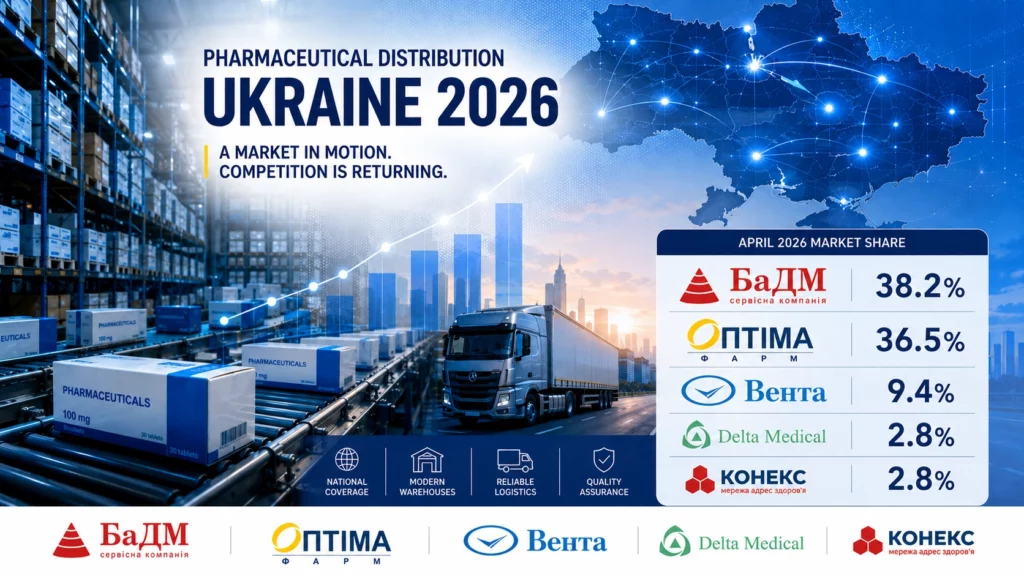
April 2026 share data shows two national leaders holding their ground while a second tier of distributors stages a credible comeback, helped by a regulatory shift toward more open access to supply contracts.
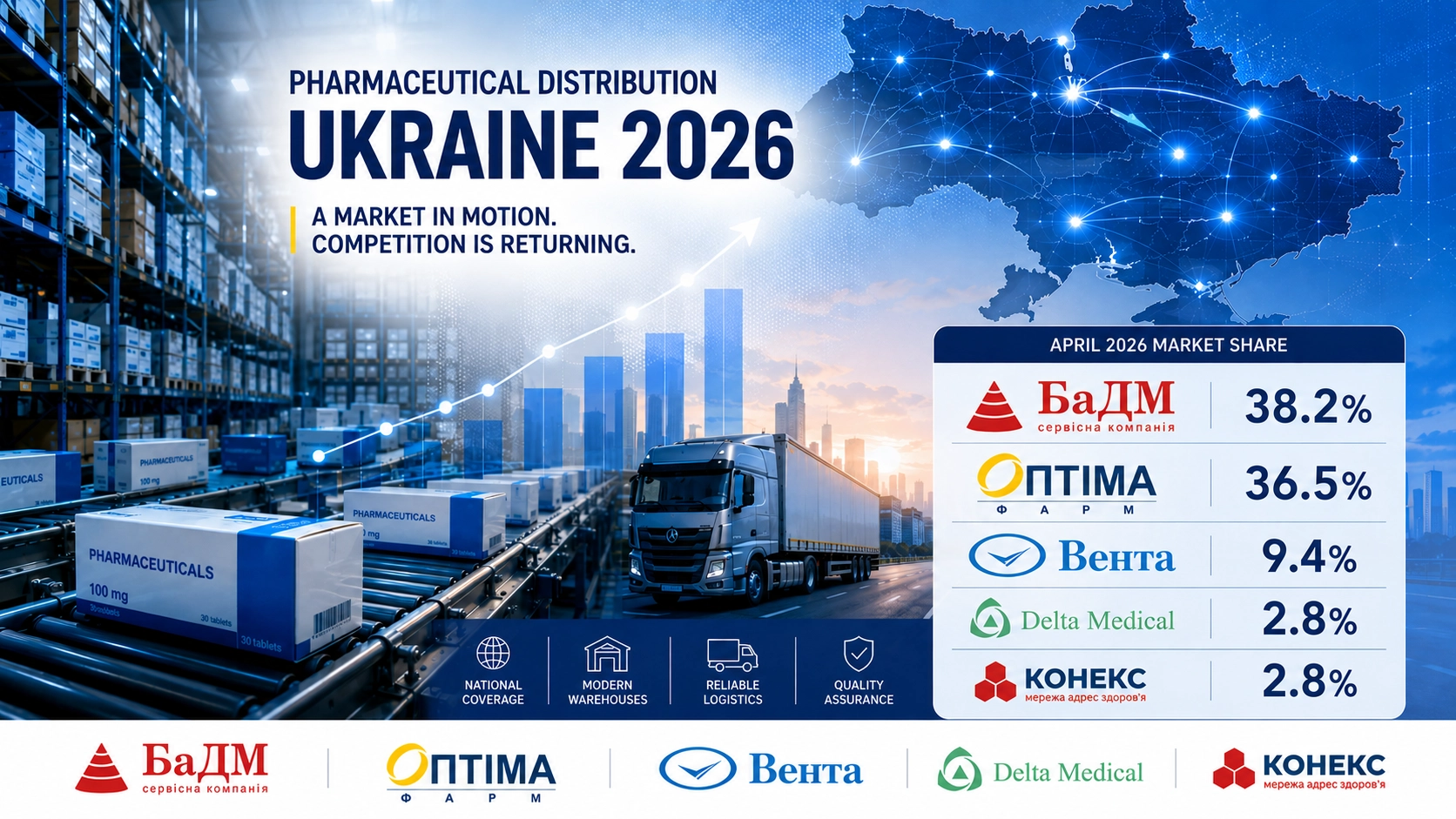
On June 3, 2026, the industry publication Apteka.ua published its April market brief and named the five largest pharmaceutical distributors in Ukraine by deliveries to pharmacies in the so-called pharmacy basket. The ranking: BaDM at 38.2%, Optima-Pharm at 36.5%, Venta at 9.4%, Delta Medical at 2.8%, and Koneks at 2.8%.
Read on its own, the table looks like a stable market with two dominant players. Read against the last two years, it tells a more interesting story. The combined position of BaDM and Optima is still commanding, but it is no longer expanding unchallenged. Venta has nearly tripled its share year over year, Koneks has more than doubled, and the structural conditions that once locked smaller distributors out of national supply contracts are loosening.
Here is the picture, player by player, and why the second tier matters more in 2026 than it has in years.
| Distributor | Apr 2024 | Apr 2025 | Apr 2026 |
| BaDM | 38.2% | ||
| Optima-Pharm | 36.5% | ||
| Venta | 2.5% | 3.2% | 9.4% |
| Delta Medical | 2.8% | ||
| Koneks | 0.6% | 1.1% | 2.8% |
Share of pharmacy-basket deliveries to pharmacies. Source: Apteka.ua, April 2026 brief (published June 3, 2026). The comparative April series broke out earlier-year figures only for Venta and Koneks; blank cells indicate years not separately reported for that distributor.
BaDM: the national anchor
BaDM ranked first in the April 2026 table with 38.2% share. BaDM is one of the two national-scale operators that form the backbone of Ukrainian pharmaceutical distribution.
BaDM presents itself as a national distributor operating since 1994, serving more than 19,000 pharmacies and medical institutions with roughly 15,000 product names. It runs scheduled and urgent deliveries, cold-chain handling, and quality systems aligned to GDP, GSP, ISO, and TQM standards. The company is also mid-way through a large warehouse expansion program, reportedly aimed at roughly doubling capacity toward 120,000 square meters by 2027, including a new automated distribution center near Kyiv.
BaDM is the safest national choice for a manufacturer that wants breadth and operational discipline. Wide reach, high customer density, and visible logistics investment during wartime are its core strengths.
Optima-Pharm: the second national platform
Opima ranked second at 36.5%. Together with BaDM, Optima forms the national distribution core that handles the large majority of medicines reaching Ukrainian pharmacies.
Optima emphasizes reliability, on-time delivery, competitive pricing, and an individual approach to clients, supported by automated order processing, electronic documentation, shipment tracking, and a client portal for order status and reporting. Optima is publicly known as one of Ukraine’s largest distributors, supplying medicines to more than 17,000 delivery points across the country.
Opima is a high-volume, well-automated second national platform, financially substantial and deeply embedded in pharmacy supply. For most large manufacturers, BaDM and Optima together remain the default route to national coverage.
Why the second tier is growing again
The Venta and Koneks numbers make more sense against the recent history of how the market concentrated in the first place.
For several years, Ukrainian distribution consolidated heavily around BaDM and Optima. That was partly a function of genuine national infrastructure. It was also a function of how pharmaceutical company supply contracts were awarded. The Antimonopoly Committee of Ukraine (AMCU), in its 2025 recommendations, identified BaDM and Optima as the largest distributors of 2021 to 2023, with a combined share above 85%, and warned that pharmaceutical manufacturer selection criteria favoring only one or two distributors could restrict competition.
AMCU described the mechanism directly: manufacturers and importers using distributor-selection criteria that only a handful of counterparties could satisfy, including outlet count, warehouse network, delivery speed, minimum sales volume, minimum order size, and existing contracts with major pharma companies. The effect was that selected distributors gained advantage not through price competition but through preferential selection criteria. Regional and alternative distributors that lost access to key supply contracts saw their businesses decline as a result.
The legal hook for change is Article 20-4 of the Law on Medicinal Products, introduced by Law No. 4239-IX (adopted February 12, 2025, in force from April 28, 2025). It requires manufacturers and importers to sell finished medicines on equal terms for price, payment, and supply conditions, with a cap of 20% of volume to any single economic entity or related group, subject to demand-based exceptions.
The reform is not uncontested. European manufacturer associations have publicly argued that parts of the law diverge from EU regulatory approaches, raising concerns about distributor quotas and the wholesale markup cap. But for the competitive question that matters here, the direction is clear: it is now harder, legally and reputationally, for a manufacturer to justify concentrating supply with one or two distributors. That has given second-tier players a genuine second chance to rebuild assortments and regain contracts.

Venta: the 2026 relaunch story
Position: ranked third at 9.4% in April 2026, up from 3.2% in April 2025 and 2.5% in April 2024. That trajectory is the single most striking movement in the table.
Venta describes itself as a large national distributor, founded in the 1990s, with a warehouse complex of around 24,000 square meters, capacity to process more than 10,000 orders a day, and regional warehouse infrastructure in Dnipro, Kyiv, Ternopil, and Odesa. It reports cooperation with more than 450 suppliers, including major international companies, and operates its own fleet with temperature-controlled transport and +2 to +8°C cold-chain capability.
The growth is not purely organic. Reporting in the business press, citing market sources, describes a coordinated market re-entry rather than a quiet recovery. Several rounds of negotiations are reported to have taken place in Vienna from the summer of 2025, involving major manufacturers, including Darnitsa and InterChem, and representatives of the largest pharmacy chains. At one of those meetings, businessman Boris Kaufman was reportedly introduced as the new owner or controlling figure behind Venta and signaled an intention to grow the company’s share. Pharma executive Oleksandr Chumak, long associated with InterChem and a former deputy health minister, is also reported to be involved. Both men are Odesa-based, a connection worth noting given InterChem’s own Odesa roots and the city’s long standing as a center of Ukrainian pharmaceutical and distribution business.
Who is Boris Kaufman: the name carries weight in Ukrainian business. Kaufman is an Odesa businessman and owner of the Vertex United group, with interests spanning hospitality, real estate, and media. He is best known as the figure behind Tedis Ukraine, the company that became the dominant national distributor of tobacco products, at its peak handling the large majority of cigarette volume in the country. A businessman who once built a commanding position in tobacco distribution now surfacing in pharmaceutical distribution is precisely why the Venta story has drawn the attention it has.
Venta has not publicly confirmed the Kaufman role, and a 24% stake tied to the company’s former Russian shareholder Katren remains under ARMA management following wartime asset measures. The commercial momentum is real and the infrastructure is substantial, but ownership and ultimate control are open due-diligence points that many future partners may wish to verify before making any deep strategic commitments.
Venta is no longer just defending legacy infrastructure. It is actively rebuilding supplier confidence, chain acceptance, and contract volume. That makes it more strategically relevant in 2026, and also more complex to assess than the two national leaders.
Koneks: the regional comeback
Koneks ranked fifth at 2.8% in April 2026, up from 1.1% in April 2025 and 0.6% in April 2024. Among the regional players, this is the clearest recovery.
Koneks combines wholesale distribution with a related pharmacy network, which gives it something most pure distributors lack: a built-in demand base. The retail arm trades under the same Koneks brand, a chain founded in 1995 that now runs more than 200 pharmacies across 11 regions of central and western Ukraine, making it one of the larger networks in the country’s center. The company describes itself as one of Ukraine’s larger pharmaceutical groups, with more than 1,200 employees, close to 800 of them holding pharmaceutical or medical qualifications. Its wholesale arm has a 25-year history, more than 10,000 wholesale items, a GDP-certified warehouse in Vinnytsia, and logistics coverage across Ukraine, including urgent delivery to medical institutions. Recent transport-management improvements at the Vinnytsia warehouse have reportedly cut weekly mileage and delivery costs while improving timing.
Koneks is a regional access and pull-through platform with central and western depth and strong pharmacy-chain linkage. Its reactivated wholesale business is visibly gaining share, and the AMCU framework explicitly recognizes it among the regional distributors now positioned to benefit from a more open market.

Delta Medical: a different kind of distributor
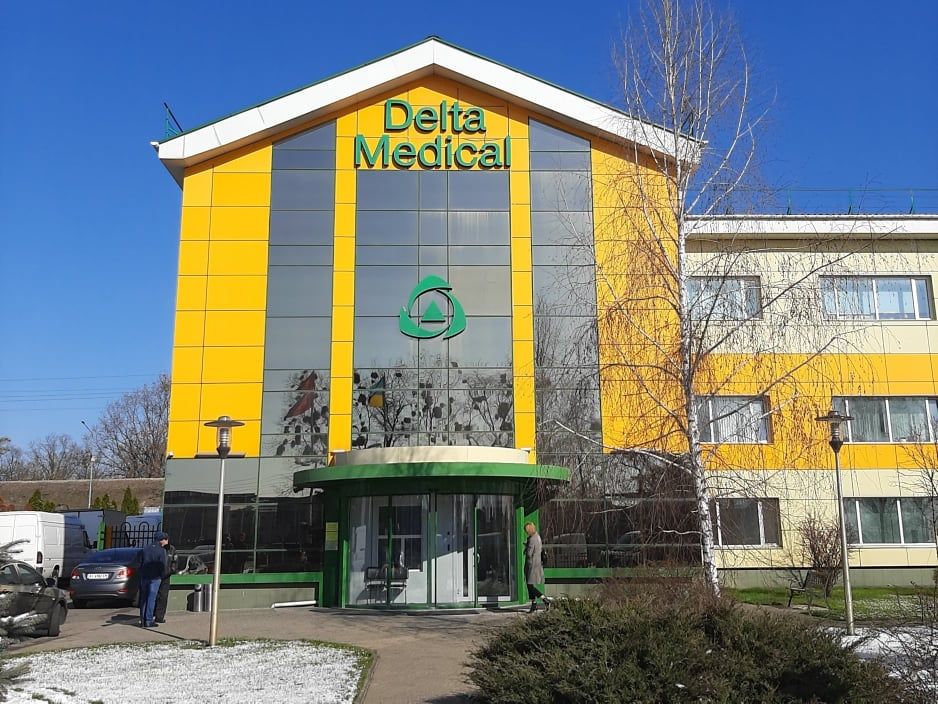
Delta Medical is ranked fourth at 2.8% in April 2026. The share figure, though, understates what Delta Medical actually is, because it is not competing on the same axis as the others.
BaDM, Optima, Venta, and Koneks are, at their core, logistics and wholesale operators. They move volume. Delta Medical operates as a value-added distributor: a partner for manufacturers whose products need more than warehousing and delivery to succeed in the market. Where a company needs medical marketing, regulatory support, launch management, or market access built around the product, Delta Medical provides those services as part of the distribution relationship.
That positioning is unusual in Ukraine. For a foreign manufacturer bringing in a specialty product, a new launch, or a portfolio that depends on physician engagement and regulatory navigation, raw delivery scale is not the binding constraint. The capability to register, position, promote, and support the product is. Delta Medical occupies that space, which is why a low pharmacy-basket share is the wrong lens for judging its role. It serves a different need, and for the right product, it serves it where the volume distributors do not compete.
Delta Medical is not an alternative to the national distributors, but a different model entirely. The relevant question is not “how much volume does it move,” but “what does the product need beyond logistics to succeed.”
The bottom line
The April 2026 table captures a market in transition. The headline is continuity: BaDM and Optima still account for roughly three-quarters of pharmacy-basket deliveries between them, and their scale, credit lines, logistics, and supplier familiarity remain real advantages.
The story underneath is de-concentration. Years of two-player dominance, reinforced by selection criteria that favored the incumbents, are being unwound by antimonopoly pressure and the equal-terms requirement of Article 20-4. Venta and Koneks are the visible beneficiaries, and their share gains are best understood not as isolated recoveries but as the early result of a market-design correction.
Distributor choice in Ukraine now carries more genuine options than it did two years ago. The right partner depends on what a given product needs: national volume from the incumbents, a fast-growing or regionally anchored challenger, or the value-added model that wraps regulatory, marketing, and market-access support around the product itself. For the first time in years, that is a real decision rather than a default.
About the Author