
The short version. An adult needs 95-110 mg of vitamin C a day, and that is easy to get from food. A Cochrane review of 29 trials found that regular supplements do not prevent colds but slightly shorten them, while starting “mega doses” after the first symptoms is almost useless. Here is where to find the most vitamin C, who really needs a supplement, and why 1,000 mg a day is usually overkill.
In short: vitamin C will not keep you from catching a cold unless you are a marathon runner in the mountains, and it will not cure one if you start the fizzy tablets once you already have a fever. But getting enough regularly shortens colds a little, and you definitely want to avoid a deficiency.
Every autumn it is the same picture: pharmacy shelves full of 1,000 mg effervescent tablets, lemons priced like mangoes, and a firm belief that vitamin C protects against everything. I am a doctor, and I understand where that belief comes from. But let’s look at what the data say.
Why your body needs vitamin C
Unlike most animals, humans cannot make ascorbic acid. We lost the enzyme for it during evolution, so we depend on food.
Vitamin C is needed to make collagen, which is why a shortage leads to bleeding gums and poor wound healing. That is classic scurvy, which once killed sailors. It improves absorption of plant-based iron, acts as an antioxidant and supports immune cells: neutrophils concentrate it at levels dozens of times higher than in the blood.
That last fact is where the belief “more vitamin C means stronger immunity” comes from. The logic makes sense, but the body does not work that way: once cells are saturated, the excess simply is not absorbed.
How much vitamin C you need per day
In 2013, the European Food Safety Authority, EFSA, set reference intakes of 110 mg a day for men and 95 mg for women. Pregnancy adds 10 mg and breastfeeding adds 60 mg. Smokers need more because smoking uses up the vitamin faster; US guidelines recommend an extra 35 mg a day.
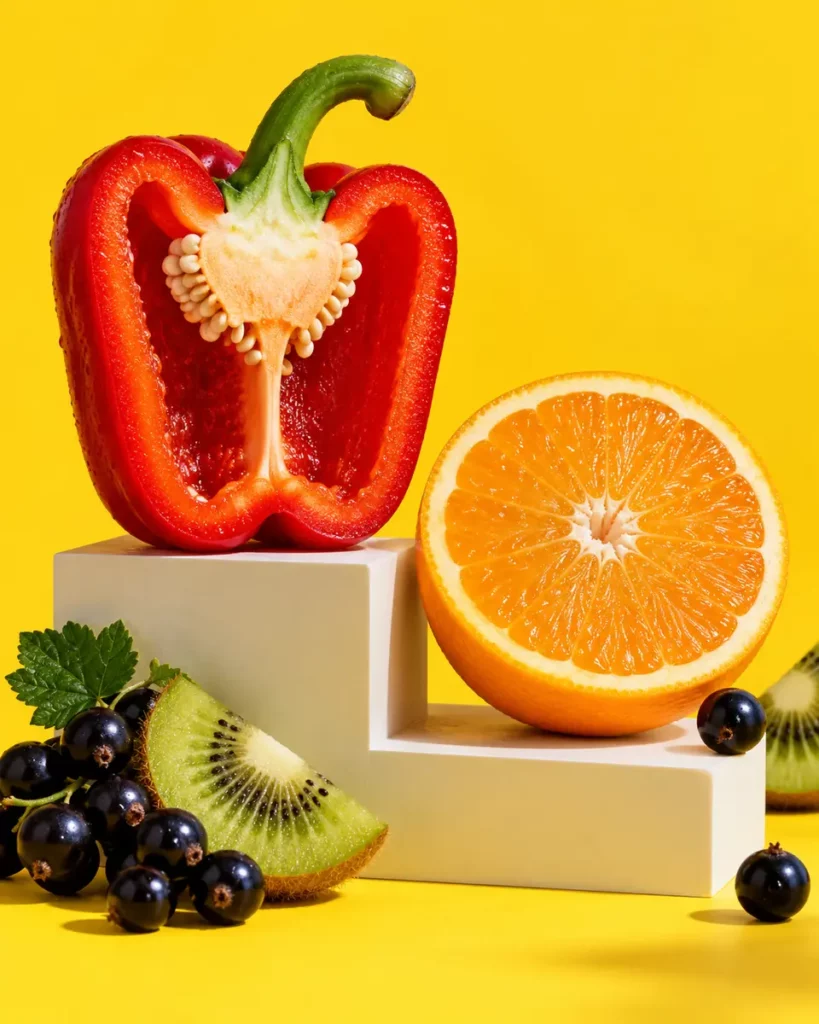
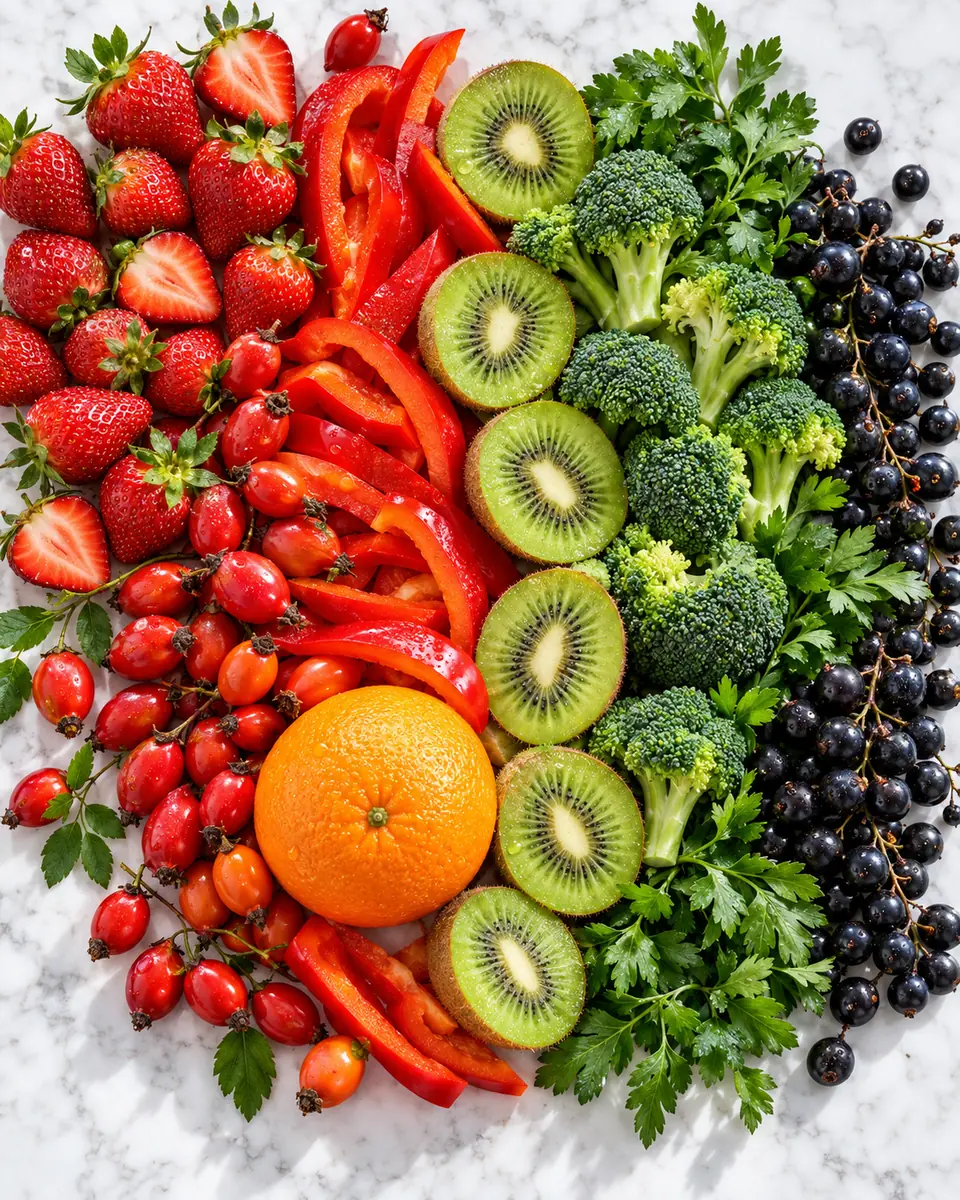
Getting this amount takes nothing special. One medium red bell pepper provides more than a day’s worth. So does a handful of blackcurrants or two kiwis. Problems start when there are almost no fresh fruits and vegetables in the diet.
| Food | Vitamin C, mg per 100 g | How much of daily needs it covers |
|---|---|---|
| Fresh rose hips | about 400 | A few berries cover a day’s needs |
| Blackcurrants | about 180 | A handful (60 g) covers your needs |
| Red bell pepper | about 130 | One pepper (150 g) gives almost twice your needs |
| Parsley | about 130 | A bunch in a salad helps noticeably |
| Kiwi | about 90 | Two kiwis cover your needs |
| Broccoli | about 90 | A 150 g serving covers your needs |
| Brussels sprouts | about 85 | A 150 g serving covers your needs |
| Strawberries | about 60 | A cup of berries gives most of your needs |
| Orange, lemon | about 50 | A medium orange gives half your needs |
| Sauerkraut | about 15 | Healthy, but not a main source |
| Potatoes | about 20 | In winter, the amount eaten makes them a real contributor |
Figures from the USDA FoodData Central database, rounded. Vitamin C breaks down with heat and leaches into water, so raw vegetables and quick steaming keep more of it than long boiling.

Vitamin C and colds: what the Cochrane reviews show
The most thorough analysis on this was done by Finnish researcher Harri Hemilä and his colleague Elizabeth Chalker for the Cochrane Library. They pooled all controlled trials in which people took at least 200 mg of vitamin C a day.
Prevention. Across 29 trials with 11,306 participants, regular supplementation did not reduce the number of colds in the general population: a relative risk of 0.97, practically no difference. The exception was people under extreme physical stress: marathon runners, skiers, and soldiers training in the cold. Their risk of catching a cold was cut in half. But unless you run a marathon every week, that is not you.
Duration. Regular supplementation shortened colds by 8% on average in adults and 14% in children. For an adult with a week-long cold, that is roughly half a day. Not a miracle, but not zero.
Treatment. When vitamin C was started after symptoms appeared, no consistent effect on duration or severity was found. So the classic “I got sick, so I drank a 1,000 mg fizzy tablet” is not backed by evidence.
My conclusion is simple. Make sure you get enough vitamin C from food every day, and you get the small benefit the studies show. Mega doses on the first day of a cold are not worth the money.

Do you need 1,000 mg or more?
In 1996, researchers at the US National Institutes of Health carefully studied how vitamin C is absorbed at different doses. Plasma and cells became saturated at just 200-400 mg a day. Above 500 mg, a shrinking share is absorbed, and the body excretes the excess in urine.
So a 1,000 mg tablet mostly turns into expensive urine. On top of that, large doses cause diarrhea and stomach discomfort in some people.
There is a more serious risk too. In a Swedish study of more than 23,000 men, those who regularly took vitamin C supplements developed kidney stones about twice as often. The mechanism is clear: some ascorbic acid is converted to oxalate, and calcium oxalate is the most common type of kidney stone.
In Ukraine, Ministry of Health Order No. 203, which we covered separately, caps vitamin C in dietary supplements at 1,000 mg per recommended daily serving. Intravenous doses of several grams, sometimes discussed in hospital settings, are a completely different story and have nothing to do with the tablets in your bag.
| Situation | What we know | What to do |
|---|---|---|
| Smokers | Use up vitamin C faster, lower blood levels | More fruit and vegetables; 100-200 mg supplement is reasonable, quitting is better |
| Poor diet without fresh fruit and vegetables | Real risk of deficiency, even scurvy | Improve the diet; a temporary 100-200 mg supplement |
| Extreme physical exertion, cold | Regular intake halved the risk of colds | Regular 200-1,000 mg during periods of heavy exertion |
| Vegetarians with low ferritin | Vitamin C improves absorption of plant iron | Add vitamin C foods to meals with legumes, grains, spinach |
| History of kidney stones | High doses raise urinary oxalate | Avoid high doses, only with your doctor’s agreement |
| Hemochromatosis (iron overload) | Vitamin C increases iron absorption | Do not take supplements without a doctor |
| G6PD deficiency | Very high doses can cause hemolysis | Only under medical supervision |
| Chronic kidney disease, dialysis | Impaired oxalate clearance | Dose set by a nephrologist |

How to choose and take vitamin C
Dose. For a healthy person who does not eat many vegetables, 100-200 mg a day is enough. Split larger doses into two.
Form. Plain ascorbic acid is absorbed just as well as pricier “buffered” forms or vitamin C with bioflavonoids. Buffered forms (sodium or calcium ascorbate) are gentler on a sensitive stomach. Liposomal vitamin C is an overpayment for most people.
Effervescent tablets. Convenient, but they contain sodium, sometimes more than 300 mg per tablet. People with high blood pressure or on a low-salt diet should keep that in mind.
Chewable tablets. The acid harms tooth enamel. Rinse your mouth with water afterwards.
What a label can promise. In the EU, approved claims for vitamin C include “contributes to the normal function of the immune system” and “contributes to normal collagen formation.” “Cures colds” or “protects against viruses” breaks the rules for food supplements.
And a reminder: in autumn, besides vitamin C, it is worth thinking about vitamin D, which your skin barely makes from October onwards.
Frequently asked questions
How much vitamin C does an adult need per day?
Does vitamin C help with colds?
Can I take 1,000 mg of vitamin C every day?
Which foods contain the most vitamin C?
Is vitamin C destroyed by cooking?
When is the best time to take vitamin C?
Who should not take vitamin C supplements without a doctor?
Conclusions
An adult needs 95-110 mg of vitamin C a day. It is easy to get from peppers, blackcurrants, kiwi, broccoli, cabbage and berries, and most people do not need a supplement.
Regular supplements do not prevent colds in ordinary people, but they shorten them slightly: by 8% in adults and 14% in children. Starting vitamin C after the first symptoms is almost useless.
Doses above 400-500 mg are poorly absorbed, and long-term use of 1,000 mg in men is linked to kidney stones. If you do need a supplement, 100-200 mg a day is enough; with kidney stones, hemochromatosis or kidney disease, talk to your doctor first.
📚 References
- Hemilä H, Chalker E. Vitamin C for preventing and treating the common cold. Cochrane Database Syst Rev. 2013;(1):CD000980. doi:10.1002/14651858.CD000980.pub4
- EFSA NDA Panel. Scientific Opinion on Dietary Reference Values for vitamin C. EFSA Journal. 2013;11(11):3418. doi:10.2903/j.efsa.2013.3418
- Levine M, Conry-Cantilena C, Wang Y, et al. Vitamin C pharmacokinetics in healthy volunteers: evidence for a recommended dietary allowance. Proc Natl Acad Sci USA. 1996;93(8):3704-3709. doi:10.1073/pnas.93.8.3704
- Thomas LDK, Elinder CG, Tiselius HG, Wolk A, Åkesson A. Ascorbic acid supplements and kidney stone incidence among men: a prospective study. JAMA Intern Med. 2013;173(5):386-388. PubMed 23381591
- Carr AC, Maggini S. Vitamin C and Immune Function. Nutrients. 2017;9(11):1211. doi:10.3390/nu9111211
- NIH Office of Dietary Supplements. Vitamin C: Fact Sheet for Health Professionals. ods.od.nih.gov
- USDA FoodData Central. fdc.nal.usda.gov
- Commission Regulation (EU) No 432/2012 establishing a list of permitted health claims made on foods. EUR-Lex
- Order of the Ministry of Health of Ukraine No. 203 of 19.02.2026, registered with the Ministry of Justice on 30.03.2026 under No. 417/45811 (in Ukrainian). zakon.rada.gov.ua/laws/show/z0417-26
About the Author