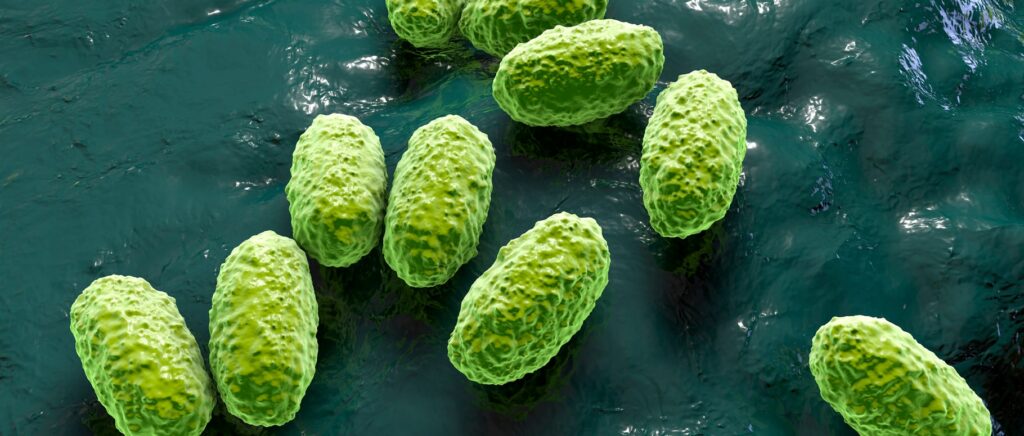
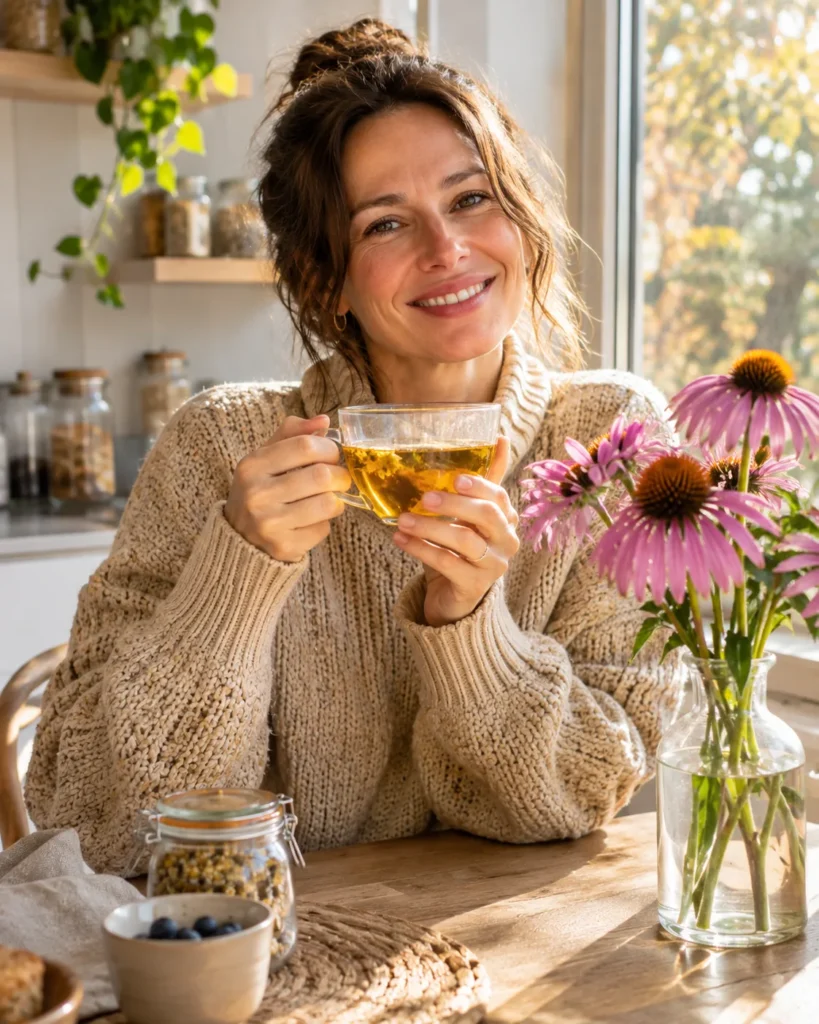
Key points. Echinacea purpurea is one of the most studied plants for colds. Taken during the season, it moderately lowers the risk of catching a cold, by about 10-20%, and by more in some studies. Once a cold has started, the effect is smaller. Not every echinacea works: the best data are for standardised products made from fresh Echinacea purpurea herb. Echinacea is not given to children under 12, people allergic to the daisy family or people with autoimmune diseases.
As a pharmacist I sell dozens of packs of echinacea every autumn. The most common question is: “Does it really work, or is it just for peace of mind?” In short: it works, but more modestly than the ads promise, and only certain products.
Here is what research shows, how to choose echinacea at the pharmacy, when to start taking it and who is better off without it.
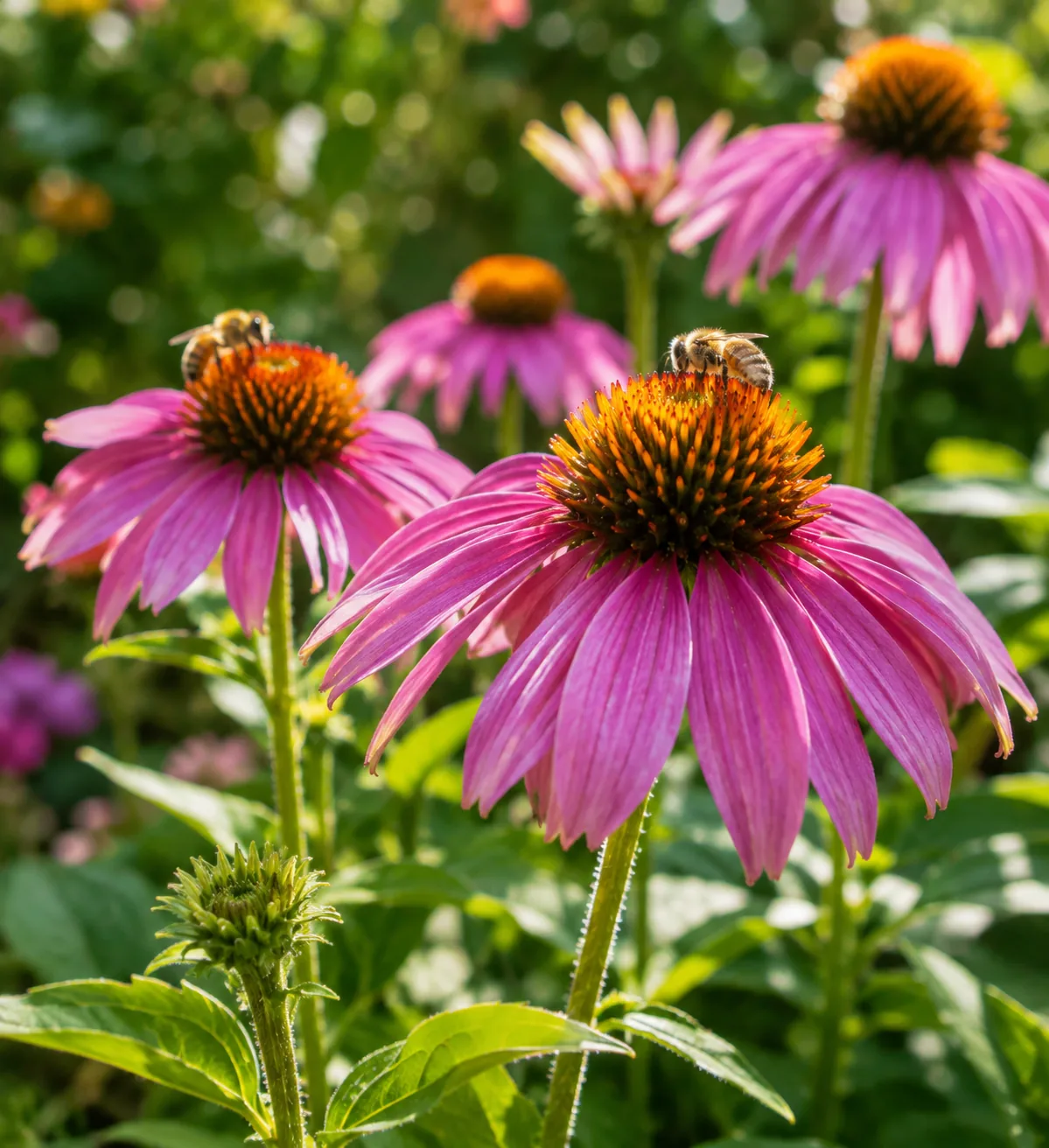
What echinacea is
Echinacea is a plant of the daisy family native to North America. Three species are used in remedies: purple coneflower, narrow-leaved and pale echinacea. Most data concern Echinacea purpurea, mainly juice and extracts of its fresh aerial parts.
Echinacea contains several groups of active substances: alkamides, polysaccharides and cichoric acid. In lab studies they activate immune cells and suppress some viruses. That is why echinacea is classed as a remedy that supports the immune response.
Does echinacea work: what studies show
There are hundreds of echinacea studies with mixed results. The reason is simple: very different products are sold under one name, from fresh herb juice to root powder of another species. Here are the key studies.
| Study | Participants | What was studied | Result |
|---|---|---|---|
| Shah, Lancet Infect Dis 2007 | Meta-analysis of 14 studies | Prevention and treatment | 58% lower odds of catching a cold, colds 1.4 days shorter on average |
| Cochrane review, 2014 | 24 studies, 4,631 participants | Prevention and treatment | Prevention: 10-20% lower risk; treatment: weak and inconsistent effect |
| Jawad, 2012 | 755 adults, 4 months | Prevention with fresh Echinacea purpurea extract | Fewer cold episodes and sick days, especially recurrent colds |
| Barrett, Ann Intern Med 2010 | 719 people with a cold | Treatment from first symptoms | Slightly shorter cold, but small difference from placebo |
| ERA-PRIMA, 2024 | 30 studies, 5,652 participants | Prevention of respiratory infections | Fewer recurrent infections and fewer antibiotic courses |
What this means in practice. Echinacea works better as prevention during cold season and for people who get sick often. Once a cold has started, it may ease it a little if you start within the first day, though the effect here is small.
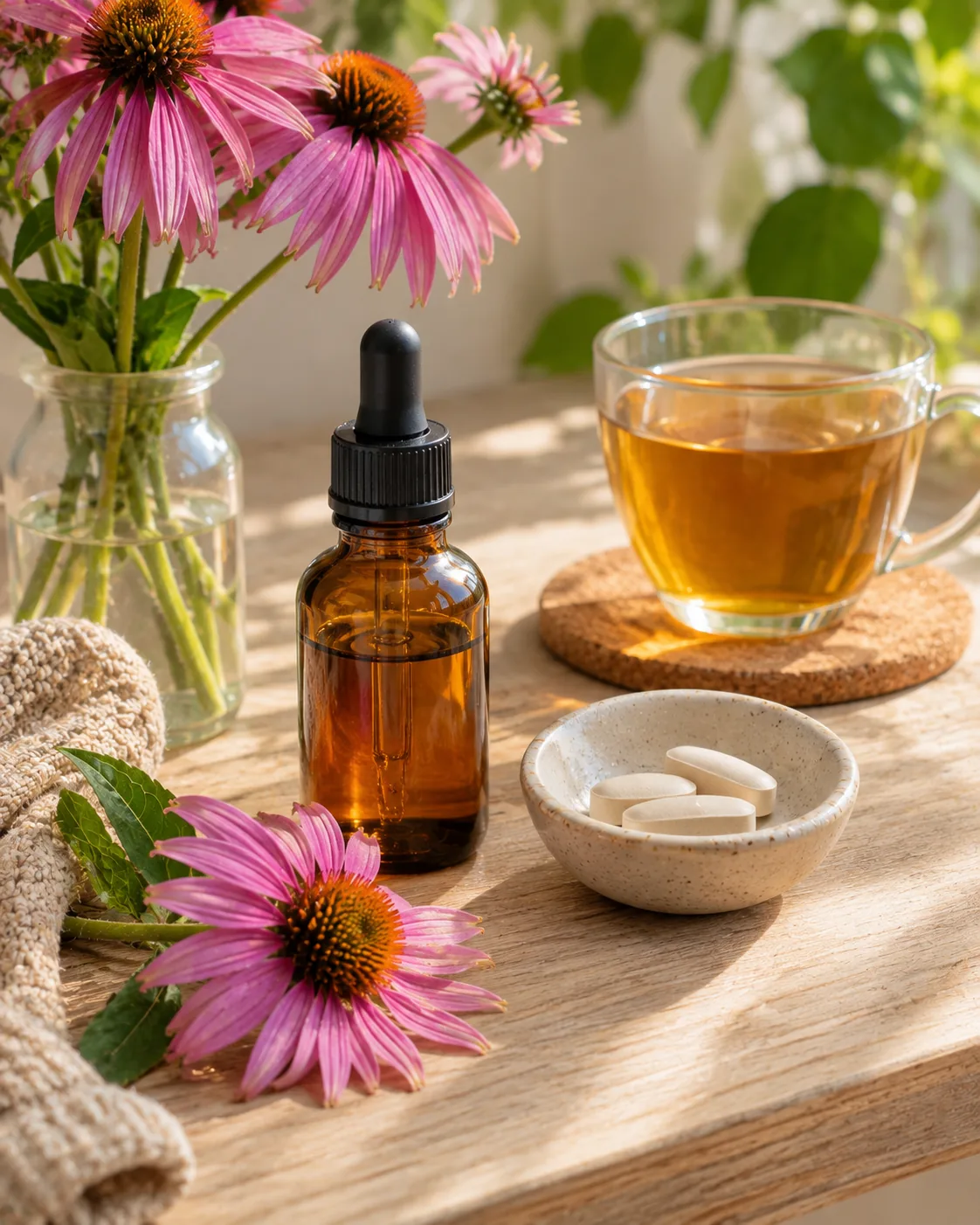
How to choose echinacea at the pharmacy
On the shelf you will see both medicines and dietary supplements with echinacea. A medicine has been registered, its composition and dose are checked, and its leaflet lists indications. A supplement complements the diet and is not meant for treatment, so the content of active substances can vary a lot between products.
| Form | Made from | What is known | What to check |
|---|---|---|---|
| Fresh herb juice | Echinacea purpurea, aerial parts | Recognised in the EU for short-term prevention and treatment of colds | Often contains alcohol |
| Standardised extract (drops, tablets) | Fresh herb and root of Echinacea purpurea | Most positive prevention studies | Look for the stated species and dose |
| Tincture | Various parts and species | Fewer data | Alcohol: not for drivers or children |
| Root powder capsules | Root of purpurea, angustifolia or pallida | Conflicting results | Species often not stated |
| Tea | Dried herb | Practically no studies | Active content unknown |
A quick rule from the pharmacy: make sure the label states Echinacea purpurea, the plant part and the amount of extract in mg per dose. If it does not, you do not know what you are buying.

How to take echinacea
For treating a cold. Start as early as possible, within the first day of symptoms: blocked nose, scratchy throat, aches. Take the dose on the label. Under the European monograph a treatment course lasts no longer than 10 days. If you are not better by then, see a doctor.
For prevention. In the Jawad study adults took a standardised extract for 4 months in a row during cold season and tolerated it well. Still, long-term use is better discussed with a doctor, especially if you have chronic conditions. Many manufacturers recommend courses with breaks.
What to combine it with. Echinacea combines well with vitamin C and zinc. But there is no need to take two or three “immune” formulas at once: their ingredients often overlap.
Alcohol-based forms. Drops and juice often contain alcohol. Avoid them before driving, if you do not drink alcohol, or if you take medicines that do not mix with it.
Who should not take echinacea
Allergy to the daisy family. If you are allergic to ragweed, chamomile, mugwort, chrysanthemums or marigold, echinacea may cause a reaction ranging from rash to swelling. People with atopy, asthma or a tendency to severe allergies should consult a doctor first.
Autoimmune and immune conditions. The European monograph does not recommend echinacea with autoimmune diseases, immunodeficiency, immunosuppressants, tuberculosis, HIV, blood disorders or progressive systemic diseases.
Children under 12. Safety at this age has not been studied enough. In an American study of children aged 2-11, echinacea did not shorten colds, but rash was more common with echinacea than with placebo.
Pregnancy and breastfeeding. Available data show no serious problems, but they are limited. So only on a doctor’s advice.
Side effects are rare: rash, itching, upset stomach, dizziness. If rash, facial swelling or difficulty breathing appear after taking it, stop and seek help.

What else helps with a cold
Echinacea only adds to the usual measures. Warm drinks, saline nasal rinses, humidified air, rest and sleep ease a cold. We covered what to do in the first 48 hours of a cold separately. And if you have high blood pressure, read about which cold medicines are safe with hypertension.
See a doctor if a fever above 38.5 °C lasts more than 3 days, you develop breathlessness, chest pain, severe ear or sinus pain, or you get worse again after improving.
Common mistakes
Starting on day three or four of a cold. The best chance of an effect is starting within the first day.
Buying any “echinacea” without a stated species and dose. Products can differ several-fold.
Giving a child “adult” echinacea. It is not recommended under 12, and tinctures also contain alcohol.
Taking it for months without a break “for immunity”. Long-term use should be discussed with a doctor.
Using echinacea instead of treatment. Tonsillitis, sinusitis, pneumonia or complicated flu need a doctor, and echinacea will not help there.
Questions and answers
Does echinacea help with colds?
How many days can you take echinacea?
Can children take echinacea?
Can you take echinacea with an autoimmune disease?
Can you take echinacea during pregnancy?
Can echinacea be combined with vitamin C and zinc?
Which is better: drops, tablets or tea?
Conclusions
Echinacea purpurea is one of the few plants with moderate evidence of benefit for colds. It works best as seasonal prevention and for people who get sick often. Once a cold has started, the effect is modest and depends on how early you begin.
Choose products that state the plant species and dose, ideally standardised products from fresh Echinacea purpurea herb. For treating a cold, keep the course to no more than 10 days.
Echinacea is not for children under 12, people allergic to the daisy family, people with autoimmune diseases or on immunosuppressants. Pregnant and breastfeeding women should see a doctor first.
📚 References
- Karsch-Völk M, Barrett B, Kiefer D, et al. Echinacea for preventing and treating the common cold. Cochrane Database Syst Rev. 2014;(2):CD000530. doi:10.1002/14651858.CD000530.pub3
- Shah SA, Sander S, White CM, Rinaldi M, Coleman CI. Evaluation of echinacea for the prevention and treatment of the common cold: a meta-analysis. Lancet Infect Dis. 2007;7(7):473-480. doi:10.1016/S1473-3099(07)70160-3
- Jawad M, Schoop R, Suter A, Klein P, Eccles R. Safety and Efficacy Profile of Echinacea purpurea to Prevent Common Cold Episodes: A Randomized, Double-Blind, Placebo-Controlled Trial. Evid Based Complement Alternat Med. 2012;2012:841315. doi:10.1155/2012/841315
- Barrett B, Brown R, Rakel D, et al. Echinacea for treating the common cold: a randomized trial. Ann Intern Med. 2010;153(12):769-777. doi:10.7326/0003-4819-153-12-201012210-00003
- Gancitano G, Mucci N, Stange R, et al. Echinacea Reduces Antibiotics by Preventing Respiratory Infections: A Meta-Analysis (ERA-PRIMA). Antibiotics. 2024;13(4):364. doi:10.3390/antibiotics13040364
- Taylor JA, Weber W, Standish L, et al. Efficacy and safety of echinacea in treating upper respiratory tract infections in children: a randomized controlled trial. JAMA. 2003;290(21):2824-2830. doi:10.1001/jama.290.21.2824
- European Medicines Agency, HMPC. European Union herbal monograph on Echinacea purpurea (L.) Moench, herba recens. EMA/HMPC/48704/2014. ema.europa.eu
About the Author