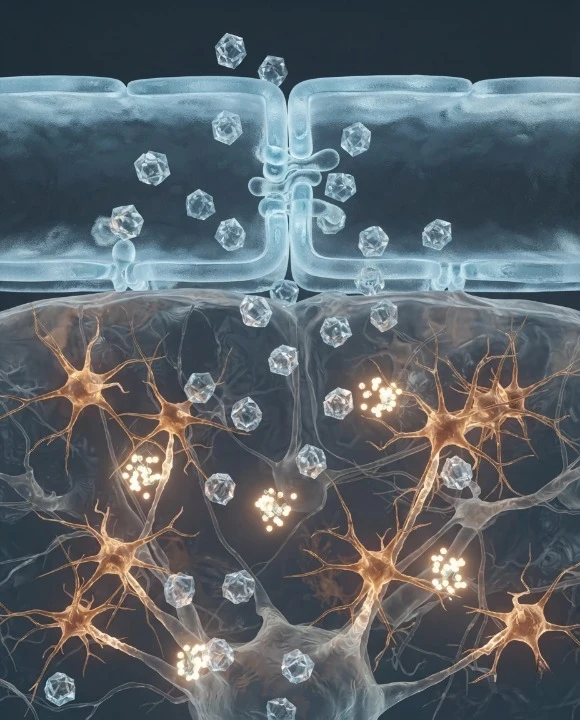
Modern scientific interest stems from the discovery that its low-molecular-weight metabolites can cross the blood-brain barrier and stimulate the endogenous synthesis of neurotrophins — nerve growth factor (NGF) and brain-derived neurotrophic factor (BDNF). This positions Lion’s Mane as one of the most promising natural candidates for supporting cognitive function, mood, and neuroplasticity.
Mechanism of Action
Stimulation of NGF and BDNF Synthesis
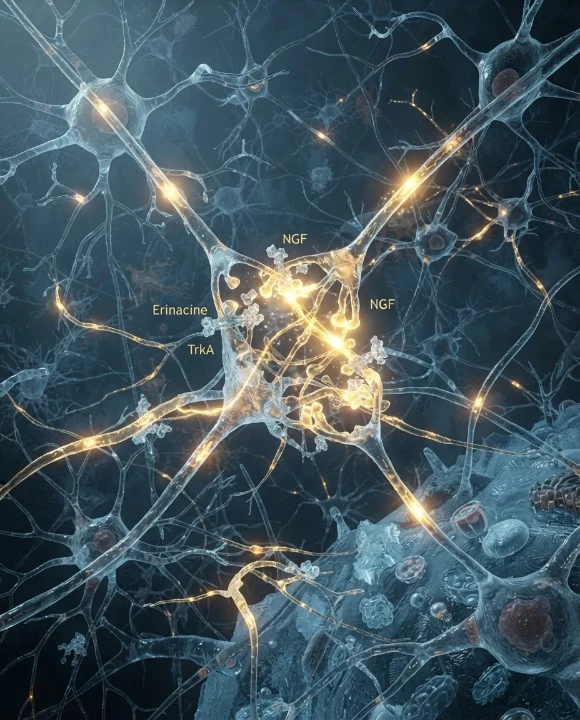
NGF is a vital protein that prevents neuronal cell death, stimulates neurite outgrowth, and maintains the structural and functional organization of neural networks; its deficiency is closely linked to neurodegenerative processes. Exogenous NGF is unsuitable as a therapeutic agent: it cannot cross the blood-brain barrier and degrades rapidly in systemic circulation. The strategic advantage of H. erinaceus lies in its bioactive compounds — hericenones and erinacines — which are low-molecular-weight molecules capable of inducing endogenous NGF synthesis directly within brain tissue. Erinacines A, B, and C were first identified as potent stimulators of NGF synthesis by Kawagishi et al. (1994).
Erinacines represent the most thoroughly characterized neuroactive class. It has been confirmed that select erinacines readily cross the blood-brain barrier (Hu et al., 2019). In a study by Shimbo et al. (2005), erinacine A increased NGF levels in the locus coeruleus and hippocampus of rats and elevated central catecholamine concentrations. Hericenones (benzyl alcohol derivatives) also stimulate NGF secretion in astroglial cells, although their potency varies across cell types.
Signaling Pathways of Neurogenesis
The underlying mechanism is far more intricate than straightforward NGF induction. In a systematic review of preclinical models, Spangenberg et al. (2025) summarized that erinacines induce NGF synthesis in astrocytes, with downstream neurogenesis mediated through high-affinity TrkA (tropomyosin receptor kinase A) receptor activation, subsequently triggering ERK1/2 (extracellular signal-regulated kinases 1/2) and PI3K/Akt (phosphoinositide 3-kinase / protein kinase B) signaling cascades. Zhang et al. (2017) demonstrated that erinacine A partially mimics the neurogenic effects of endogenous NGF in cortical neurons. Furthermore, in transgenic APPswe/PS1dE9 mice (a standard model of Alzheimer’s disease), erinacine A-enriched mycelium significantly attenuated β-amyloid plaque deposition and ameliorated Alzheimer’s-related neuropathology (Tsai-Teng et al., 2016).
| Bioactive Compound | Molecular Target / Mechanism | Neurophysiological Outcome |
|---|---|---|
| Erinacines (A, B, C, etc.) | BBB permeability, astrocytic NGF induction, TrkA–ERK1/2–PI3K/Akt activation | Stimulation of neurogenesis, neurite branching, reduction of β-amyloid plaques |
| Hericenones | Stimulation of nerve growth factor (NGF) secretion in astroglial cells | Support of neuronal survival and functional synaptic plasticity |
| β-Glucans (Polysaccharides) | Immune modulation (NF-κB, MAPK), microbiome enrichment (Akkermansiaceae) | Enhanced butyrate synthesis, systemic neuro-immune regulation via the gut-brain axis |
Studies Demonstrating Clinical Efficacy

| Study | Participants / Cohort | Protocol / Dosage | Key Clinical Finding |
|---|---|---|---|
| Mori et al. (2009) | 30 adults aged 50–80 with MCI (RCT) | ≈3 g/day powder, 16 weeks | Significant improvement in HDS-R cognitive scores (cumulative, reversible upon cessation) |
| Li et al. (2020) | Early-stage Alzheimer’s disease (RCT) | Erinacine A-enriched mycelium, 49 weeks | Significant gains in MMSE and IADL scores, improved visual contrast sensitivity |
| Docherty et al. (2023) | 41 healthy young adults aged 18–45 (RCT) | 1.8 g mushroom (acute and 28 days) | Faster Stroop test execution at 60 min, trend toward subjective stress reduction at 28 days |
| Surendran et al. (2026) | 109 adults aged 40–75 (RCT) | 2 g biomass, 8 weeks | Significant improvements in visual attention, working memory, sleep quality, and mood |
| Vigna et al. (2019) | 77 adults with mood/sleep disorders | Mushroom extract, 8 weeks | Reductions in depression and anxiety, elevation of circulating pro-BDNF biomarkers |
Mild Cognitive Impairment (Mori, 2009)
The most widely cited clinical study is a double-blind, placebo-controlled randomized clinical trial (RCT) involving 30 participants aged 50–80 with mild cognitive impairment (MCI) receiving ≈3 g of mushroom powder daily for 16 weeks. At weeks 8, 12, and 16, the intervention group exhibited significantly higher cognitive scores on the Revised Hasegawa Dementia Scale (HDS-R) compared to placebo. Following treatment cessation, cognitive scores gradually regressed toward baseline, demonstrating that therapeutic benefits are maintenance-dependent and require sustained intake.
Early-Stage Alzheimer’s Disease (Li, 2020)
A 1-year double-blind, placebo-controlled pilot RCT (NCT04065061) evaluated 49 weeks of supplementation with erinacine A-enriched mycelium. The intervention group demonstrated statistically significant improvements on the Mini-Mental State Examination (MMSE) and the Instrumental Activities of Daily Living (IADL) scale relative to placebo, alongside improved visual contrast sensitivity, while the placebo arm showed progressive cognitive decline over the 1-year duration.
Healthy Adults: Cognition and Processing Speed
- Saitsu (2019). In an RCT evaluating 12 weeks of fruiting body supplementation in healthy adults, significant improvements in MMSE cognitive scores were documented.
- Docherty (2023). In an RCT involving 41 healthy adults aged 18–45 receiving 1.8 g of mushroom, acute intake resulted in significantly faster Stroop task completion at 60 minutes post-dose (p = 0.005); chronic 28-day supplementation showed a trend toward reduced subjective stress (p = 0.051).
- Large-Scale RCT by Surendran et al. (2026, preprint). In a remote trial of 109 adults aged 40–75 reporting subjective memory complaints, 8 weeks of 2 g daily fruiting body and mycelial biomass produced significant advantages over placebo in visual sustained attention, working memory, sleep quality, morning alertness, and overall mood — representing one of the largest positive cohorts to date.
- Černelič Bizjak et al. (2024). A pilot 8-week RCT using erinacine A-enriched mycelium (33 participants) showed cognitive gains (perceptual processing speed) accompanied by increased gut microbiota alpha-diversity and elevated serum pro-BDNF levels in the active group, supporting the hypothesized neurotrophic and gut-brain mechanisms.
Mood, Anxiety, and Sleep Quality
- Nagano (2010). 30 female participants consuming Lion’s Mane-infused cookies for 4 weeks exhibited significant reductions in depressive symptom severity and “indefinite complaints” (irritability, anxiety, concentration difficulties).
- Vigna (2019). 77 individuals with overweight/obesity and comorbid mood/sleep disturbances receiving extract for 8 weeks demonstrated significant decreases in depression, anxiety, and sleep disorders, accompanied by elevated circulating pro-BDNF levels proposed as a responsive biomarker.
Overall, mood-related findings align with the neurotrophic hypothesis; a review by Chong et al. (2020) comprehensively details the therapeutic potential of the mushroom in depressive disorders. An independent pilot study by Okamura et al. (2015) using standardized Amyloban® 3399 (0.5% hericenones) reported improvements in subjective sleep quality and well-being among female undergraduate students.
For a rigorous and balanced perspective, null findings must also be acknowledged. Not all trials demonstrated efficacy: Grozier et al. (2022) found no significant changes in metabolic flexibility or cognitive markers after 4 weeks of 10 g daily intake in 24 healthy adults, and Surendran et al. (2025) observed no composite cognitive score changes following single acute doses. The prevailing scientific explanation suggests that in cognitively intact populations with normative baseline neurotrophic activity, physiological headroom for acute improvement is limited, and short intervention windows (under 4 weeks) are often insufficient — mood and sleep benefits typically require ≥2 months of chronic intake to manifest robustly.
Historical Context and Modern Applications
In traditional East Asian medicine, Lion’s Mane was utilized for centuries: in China, it was known as “hou tou gu” (“monkey head mushroom”) and prized for fortifying the stomach, spleen, and central nervous system, while in Japanese tradition (Yamabushitake), it was associated with nerve health and digestive harmony. Historical accounts describe Yamabushi ascetic mountain monks consuming tea brewed from the fungus to sustain intense concentration during prolonged meditation sessions — functioning as an early ancestral “protonootropic.” Modern scientific interest experienced a major resurgence following the structural isolation of its neurotrophic diterpenoids in the 1990s and clinical studies in the early 2000s.
Today, H. erinaceus is firmly established in daily nutritional and wellness practices. As a culinary ingredient, it offers a delicate texture often likened to lobster or crab, and is widely prepared in soups, sautés, and as a functional meat alternative. In the supplement industry, it represents one of the most widely consumed “nootropic” functional mushrooms across capsules, extract powders, and cognitive beverage formulations. A comprehensive systematic review detailing its benefits, applications, and safety profile was published by Menon et al. (2025).
Practical enthusiasm for Lion’s Mane across biohacking, athletic, and cognitive optimization communities significantly outpaces academic timelines and remains largely empirical. It draws upon traditional herbalism, compelling preclinical mechanisms (such as in vitro neurite branching), and anecdotal self-reports rather than vast, definitive clinical trial databases in healthy individuals. Consequently, individual experiential reports should be regarded as valuable working hypotheses rather than medically proven outcomes.
Future Research Directions
- Large-Scale RCTs in Healthy Cohorts. While robust evidence exists for populations with baseline cognitive decline, expansive, high-powered trials in healthy younger and middle-aged adults are necessary to definitively validate nootropic enhancement claims.
- Standardization of Bioactive Fractions. Commercial products vary widely in chemical composition depending on whether fruiting body or mycelium is used; future research demands standardized preparations with quantified erinacine and hericenone concentrations to ensure cross-study reproducibility.
- Biomarker Validation. Validating peripheral circulating BDNF and pro-BDNF levels as reliable clinical surrogates of central neurotrophic response across larger demographic cohorts (Vigna 2019; Černelič Bizjak 2024).
- Neurodegenerative Disease Interventions. Encouraging pilot findings in early Alzheimer’s disease (Li 2020) and preclinical β-amyloid reduction data (Tsai-Teng 2016) justify phase II/III RCTs with extended durations and hard clinical endpoints.
- Gut-Brain Axis Interactions. Further mechanistic studies connecting specific shifts in gut microbiota diversity and short-chain fatty acid kinetics to measurable mood and cognitive outcomes.
- ADHD and Neuropsychiatric Indications. Preclinical models in spontaneously hypertensive rats (SHR, a standard model of ADHD) and computational docking studies targeting the serotonin transporter SLC6A4 provide early hypotheses awaiting formal human validation.
Conclusion
Hericium erinaceus represents a highly promising natural nutraceutical for supporting cognitive capabilities (memory retention, executive attention, and processing speed), mood stability, and sleep quality. It is supported by a biologically plausible and increasingly detailed neurotrophic mechanism: its diterpenoid erinacines penetrate the blood-brain barrier to stimulate endogenous NGF and BDNF synthesis via TrkA–ERK1/2–PI3K/Akt signaling, while its β-glucan polysaccharides exert peripheral immunomodulatory and gut-microbial benefits. Clinical evidence is strongest in individuals with mild cognitive impairment, with emerging high-quality trials (Surendran 2026) providing encouraging support in healthy cohorts. While the clinical evidence base continues to mature regarding optimal dosing and chronic duration, ongoing standardized trials will further solidify Lion’s Mane’s definitive therapeutic role in cognitive health and neuroprotection.
References
- Černelič Bizjak M., Jenko Pražnikar Z., Kenig S., Hladnik M., Bandelj D., Gregori A., Kranjc K. Effect of erinacine A-enriched Hericium erinaceus supplementation on cognition: a randomized, double-blind, placebo-controlled pilot study. Journal of Functional Foods. 2024;115:106120. doi:10.1016/j.jff.2024.106120.
- Chong P. S., Fung M.-L., Wong K. H., Lim L. W. Therapeutic Potential of Hericium erinaceus for Depressive Disorder. International Journal of Molecular Sciences. 2020;21(1):163.
- Docherty S., Doughty F. L., Smith E. F. The Acute and Chronic Effects of Lion’s Mane Mushroom Supplementation on Cognitive Function, Stress and Mood in Young Adults. Nutrients. 2023;15(22):4842. PMID: 38004235.
- Friedman M. Chemistry, Nutrition, and Health-Promoting Properties of Hericium erinaceus (Lion’s Mane) Mushroom Fruiting Bodies and Mycelia and Their Bioactive Compounds. Journal of Agricultural and Food Chemistry. 2015;63(32):7108–7123.
- Grozier C., Alves V., Killen L. G. et al. Four Weeks of Hericium erinaceus Supplementation Does Not Impact Markers of Metabolic Flexibility or Cognition. International Journal of Exercise Science. 2022;15(2):1366–1380.
- Hu J.-H., Li I.-C., Lin T.-W. et al. Absolute Bioavailability, Tissue Distribution, and Excretion of Erinacine S in Hericium erinaceus Mycelia. Molecules. 2019;24(8):1624. doi:10.3390/molecules24081624. PMID: 31022946.
- Kawagishi H., Shimada A., Shirai R. et al. Erinacines A, B and C, strong stimulators of nerve growth factor (NGF)-synthesis, from the mycelia of Hericium erinaceum. Tetrahedron Letters. 1994;35(10):1569–1572.
- Li G. et al. (Review). Hericenones and erinacines: stimulators of nerve growth factor (NGF) biosynthesis in Hericium erinaceus. Mycology. 2010;1(2):92–98.
- Li I.-C., Chang H.-H., Lin C.-H. et al. Prevention of Early Alzheimer’s Disease by Erinacine A-Enriched Hericium erinaceus Mycelia Pilot Double-Blind Placebo-Controlled Study. Frontiers in Aging Neuroscience. 2020;12:155. NCT04065061.
- Menon A., Jalal A., Arshad Z. et al. Benefits, side effects, and uses of Hericium erinaceus as a supplement: a systematic review (PRISMA; PROSPERO CRD42024571250). Frontiers in Nutrition. 2025. PMID: 40959699.
- Mori K., Inatomi S., Ouchi K., Azumi Y., Tuchida T. Improving effects of the mushroom Yamabushitake (Hericium erinaceus) on mild cognitive impairment: a double-blind placebo-controlled clinical trial. Phytotherapy Research. 2009;23(3):367–372. PMID: 18844328.
- Nagano M., Shimizu K., Kondo R. et al. Reduction of depression and anxiety by 4 weeks Hericium erinaceus intake. Biomedical Research. 2010;31(4):231–237. PMID: 20834180.
- Okamura H., Anno N., Tsuda A. et al. The effects of Hericium erinaceus (Amyloban® 3399) on sleep quality and subjective well-being among female undergraduate students: a pilot study. Personalized Medicine Universe. 2015;4:76–78.
- Saitsu Y., Nishide A., Kikushima K., Shimizu K., Ohnuki K. Improvement of cognitive functions by oral intake of Hericium erinaceus. Biomedical Research (Tokyo). 2019;40(4):125–131.
- Shimbo M., Kawagishi H., Yokogoshi H. Erinacine A increases catecholamine and nerve growth factor content in the central nervous system of rats. Nutrition Research. 2005;25(6):617–623.
- Spangenberg E. T., Moneypenny A., Bozzo G. G., Perreault M. L. Unveiling the role of erinacines in the neuroprotective effects of Hericium erinaceus: a systematic review in preclinical models. Frontiers in Pharmacology. 2025;16:1582081.
- Surendran G., Saye J., Binti Mohd Jalil S. et al. Acute effects of a standardised extract of Hericium erinaceus on cognition and mood in healthy younger adults. Frontiers in Nutrition. 2025;12:1405796. doi:10.3389/fnut.2025.1405796.
- Surendran G. et al. A randomized, double-blind, placebo-controlled study evaluating the impact of Hericium erinaceus (Lion’s Mane) on cognitive performance and subjective wellbeing (109 participants, 8 weeks; preprint). medRxiv. 2026. doi:10.64898/2026.04.13.26350781.
- Tsai-Teng T., Chin-Chu C., Li-Ya L. et al. Erinacine A-enriched Hericium erinaceus mycelium ameliorates Alzheimer’s disease-related pathologies in APPswe/PS1dE9 transgenic mice. Journal of Biomedical Science. 2016;23:49.
- Vigna L., Morelli F., Agnelli G. M. et al. Hericium erinaceus Improves Mood and Sleep Disorders in Patients Affected by Overweight or Obesity. Evidence-Based Complementary and Alternative Medicine. 2019;2019:7861297.
- Yang Y., Ye H., Zhao C. et al. Value-added immunoregulatory polysaccharides of Hericium erinaceus and their effect on the gut microbiota. Carbohydrate Polymers. 2021;262:117668. PMID: 33838836.
- Zhang J., An S., Hu W. et al. Erinacine A partially mimics the neurogenic effects of NGF in cortical neurons. International Journal of Molecular Sciences. 2017;18(9):1810. doi:10.3390/ijms18091810.