Mechanism of Action
Cordycepin as an Adenosine Analog and AMPK Activator
The central bioactive molecule is cordycepin (3′-deoxyadenosine), a structural analog of adenosine. Its precise interaction with cellular energy metabolism was elucidated in detail by Hawley et al. (2020). Cordycepin enters the cell via equilibrative nucleoside transporters (ENT1/ENT2) and undergoes intracellular phosphorylation into mono-, di-, and triphosphates. The active form is cordycepin monophosphate (CoMP), which mimics the allosteric activating effects of AMP (adenosine monophosphate) on AMP-activated protein kinase (AMPK). AMPK functions as the master cellular “energy sensor”: when the AMP/ATP ratio rises — such as during physical exertion — it shifts metabolism toward energy generation, enhancing glucose uptake, fatty acid oxidation, and mitochondrial biogenesis. In this way, Cordyceps effectively “mimics” key physiological signals normally triggered by exercise.
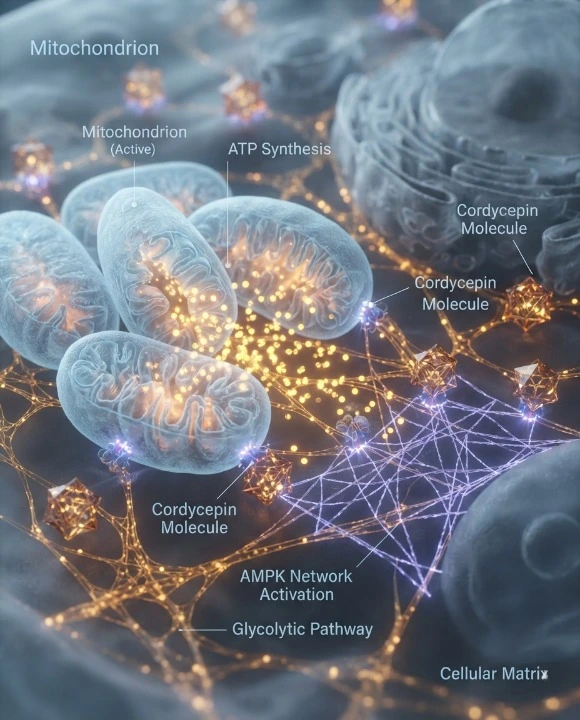
Mitochondrial Biogenesis and Muscle Metabolic Regulators
In preclinical research by Kumar et al. (2011), rats supplemented with C. sinensis (CS) mycelium demonstrated a 1.8- to 2.9-fold increase in swimming endurance capacity. Mechanistically, researchers observed upregulated expression of AMPK, PGC-1α (peroxisome proliferator-activated receptor-γ coactivator-1α, the master regulator of mitochondrial biogenesis), and PPAR-δ (peroxisome proliferator-activated receptor-δ) — pivotal regulators of oxidative metabolism. Additionally, there was increased expression of lactate transporters MCT1/MCT4 (monocarboxylate transporters) and GLUT4 (glucose transporter 4), facilitating enhanced glucose and lactate handling; VEGF (vascular endothelial growth factor, promoting angiogenesis); and the antioxidant NRF-2 pathway with downstream targets SOD1 (superoxide dismutase 1) and TRX (thioredoxin), attenuating exercise-induced oxidative stress. Together, these pathways provide a biologically plausible basis for the cumulative endurance-enhancing effects observed over weeks of supplementation.
Adenosine Receptors, Blood Flow, and Oxygen Utilization
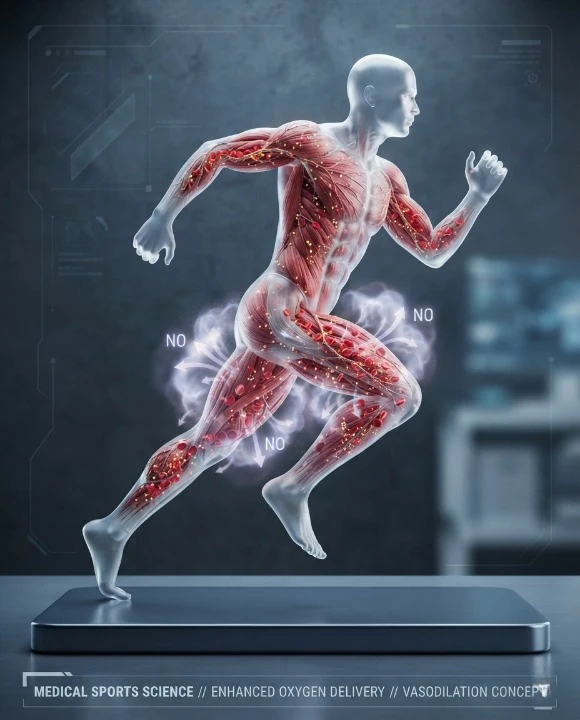
Beyond AMPK, cordycepin modulates adenosine receptors (subtypes A1, A2A, A2B, A3), which accounts for its diverse systemic actions ranging from neuroprotection to endocrine regulation (Leu et al., 2011; review by Das et al., 2021). Traditionally, the ergogenic effects of Cordyceps are also linked to improved oxygen delivery and utilization: protein and nucleoside constituents of C. sinensis exhibit vasorelaxant properties, and the fungus upregulates nitric oxide (NO) production via inducible NO synthase. Vasodilation and augmented microcirculatory blood flow enhance muscle perfusion and accelerate lactate clearance during intense exercise.
Anti-Fatigue, Endocrine, and Immunomodulatory Effects
In numerous forced swimming models, Cordyceps significantly prolonged time to exhaustion while improving biochemical markers of fatigue — reducing serum lactate, blood urea nitrogen (BUN), and creatine kinase, while preserving muscle glycogen reserves and boosting antioxidant enzyme activities (superoxide dismutase SOD, catalase, glutathione peroxidase GSH-Px). An independent preclinical research avenue focuses on steroidogenesis: cordycepin stimulated testosterone biosynthesis in Leydig cells via the cAMP–PKA (cyclic adenosine monophosphate – protein kinase A) cascade and adenosine receptor signaling (Leu et al., 2011), aligning with the traditional use of the fungus as a restorative tonic. Furthermore, Cordyceps polysaccharides exert immunomodulatory actions — augmenting natural killer (NK) cell cytotoxicity, lymphocyte proliferation, and regulatory cytokine secretion.
| Biomolecular Target | Mechanism of Cordycepin Action | Physiological Outcome |
|---|---|---|
| AMPK (Energy Sensor) | CoMP mimics AMP, activating the AMPK kinase network | Enhanced glucose uptake, fatty acid oxidation, and ATP stimulation |
| Mitochondrial Biogenesis | Upregulation of PGC-1α and PPAR-δ expression | Increased mitochondrial density and volume in skeletal muscle |
| Vascular Bed & NO | Stimulation of nitric oxide synthesis, action on adenosine receptors | Vasodilation, improved muscle perfusion, and accelerated lactate clearance |
| Antioxidant Defense | Activation of the NRF-2 pathway (SOD1, TRX, catalase) | Reduction of exercise-induced oxidative stress |
| Endocrine System | Stimulation of Leydig cells via the cAMP–PKA signaling pathway | Support of steroidogenesis and anabolic recovery |
Preclinical and Clinical Studies
| Study | Participants / Model | Protocol / Dosage | Key Documented Result |
|---|---|---|---|
| Hirsch (2017) | 28 active adults (RCT) | C. militaris blend 4 g/day, 3 weeks | Significant increases in VO2max (+4.8 mL/kg/min), time to exhaustion (+69.8 s), and ventilatory threshold |
| Chen (2010) | Healthy older adults 50–75 yrs (RCT) | Cs-4 ≈3 g/day, 12 weeks | Elevated metabolic threshold (+10.5%) and ventilatory threshold (+8.5%) without stimulant-induced tachycardia |
| Pasha (2024) | 48 athletes | C. militaris infusion, 3 weeks | Improved blood oxygen saturation (SpO2) and prolonged time to fatigue onset |
| Kumar (2011) | Rats (swimming model) | C. sinensis mycelium | 1.8- to 2.9-fold increase in endurance capacity driven by AMPK/PGC-1α pathway activation |
| Parcell (2004) | Trained cyclists | Cs-4, 5 weeks | Absence of VO2peak gains, likely attributable to a “ceiling effect” in elite-adapted athletes |
Endurance and Aerobic Performance — Clinical Evidence
- Hirsch (2017). In a randomized, double-blind, placebo-controlled trial involving 28 recreationally active adults supplementing with a mushroom blend containing C. militaris (4 g/day), 3 weeks of intake produced significant gains in VO2max (+4.8 mL·kg⁻¹·min⁻¹), time to exhaustion (+69.8 s), and ventilatory threshold. Notably, these changes were not statistically apparent after 1 week, demonstrating the cumulative, chronic nature of adaptation.
- Chen (2010). In healthy older adults aged 50–75 supplementing with Cs-4 (≈3 g/day) for 12 weeks, the metabolic threshold (the workload at which lactate begins to accumulate) increased by 10.5%, and the ventilatory threshold rose by 8.5%, indicating enhanced aerobic exercise tolerance without the tachycardia typical of classic stimulants; VO2max remained unchanged. Earlier work (Nicodemus, 2001) using 4.5 g/day in trained males similarly reported increases in VO2max, ventilatory threshold, and delayed lactate onset.
- Pasha (2024). In a cohort of 48 athletes consuming a C. militaris infusion for 3 weeks, researchers recorded higher blood oxygen saturation (SpO2) and delayed fatigue, which the authors attributed to superior tissue oxygen availability.
Preclinical Evidence on Exercise Capacity
- Kumar (2011). Documented a 1.8- to 2.9-fold increase in swimming endurance in rodents alongside activation of the AMPK/PGC-1α/PPAR-δ/NRF-2 network (see Section 1.2), establishing the primary biomolecular framework of action.
- Choi et al. (2020). An ethyl acetate extract of C. militaris enhanced exercise performance, an outcome primarily attributed to upregulated cellular ATP production rather than direct suppression of peripheral muscle fatigue.
- Anti-Fatigue Models. Cordyceps polysaccharides consistently extended swimming duration and optimized post-exercise biochemical markers (lactate, BUN, glycogen preservation, antioxidant enzyme activity).
Synthesis of the Evidence Base
A recent narrative review of human trials (Jędrejko et al., 2026; 5 intervention trials, 321 participants) confirms ergogenic signals regarding VO2max, time to exhaustion, and power output, while defining priorities for future research: standardized formulations and homogeneous athletic cohorts. A crucial nuance for a balanced perspective is that in well-trained cyclists, Parcell (2004) observed no significant improvement in VO2peak — likely due to a “ceiling effect” in already highly adapted elite athletes, whereas untrained individuals and older populations have substantially wider headroom for physiological gains. This informs the future research focus: identifying exactly which populations and dosage strategies derive maximum benefit.
Promising Research Directions

- Standardized Preparations. Future RCTs must implement preparations with verified, quantified concentrations of cordycepin and adenosine to ensure reproducibility and cross-study comparability (a priority emphasized in the Jędrejko et al., 2026 review).
- Response Profiles. Delineating target populations that achieve the greatest physiological gains (untrained individuals, older adults, endurance athletes), optimal dosing ranges (3–4.5 g/day appears most promising), and duration (cumulative benefit emerging at ≥3 weeks) — consistent with the “ceiling effect” in elite athletes (Parcell, 2004) versus documented gains in untrained cohorts (Chen, 2010; Jędrejko et al., 2026).
- Post-Exercise Recovery and Biomarkers. Investigating impacts on post-exercise recovery kinetics, circulating cortisol, inflammatory cytokines, and human mitochondrial bioenergetics (outlined by Jędrejko et al., 2026).
- Endocrine Dynamics. Translating preclinical evidence on steroidogenesis and testosterone production into rigorous, placebo-controlled human clinical trials (preclinical foundation: Leu et al., 2011; review: Chen et al., 2017).
- Pharmacokinetics and Bioavailability. Cordycepin undergoes rapid enzymatic deamination in vivo; promising strategies include advanced delivery systems and pairing with adenosine deaminase inhibitors to prolong biological half-life (reviews by Tuli et al., 2014; Ashraf et al., 2020).
- High-Altitude Adaptation and Respiratory Function. Traditional use in hypoxic environments and clinical signals regarding tissue oxygenation justify targeted investigations under hypobaric hypoxia and in respiratory conditions (vasorelaxant basis: Chiou et al., 2000; oxygenation data: Pasha et al., 2024).
Historical Context and Modern Applications
In traditional Chinese and Tibetan medicine, Cordyceps (“dong chong xia cao” — “winter worm, summer grass”) was revered for centuries as a rare, precious tonic to restore physical vigor and stamina; during the Ming Dynasty, access was largely reserved for the imperial court. The fungus captured global attention in 1993 when coach Ma Junren attributed a series of world records set by Chinese female distance runners to Cordyceps supplementation — though those performances subsequently became embroiled in doping controversies, making this episode an initial historical catalyst for global interest rather than definitive clinical proof.
From there, Cordyceps entered modern wellness culture and established itself as a widely utilized “functional” supplement (whole fruiting body powders, concentrated standardized extracts, functional beverages), valued by biohackers and endurance athletes as a “clean,” non-jittery energy source — in contrast to central nervous system stimulants like caffeine. This practical enthusiasm significantly outpaces formal academic literature and remains largely empirical: it rests on tradition, preclinical mechanisms, and anecdotal observations rather than large-scale clinical trials. Consequently, real-world usage should be regarded as a collection of promising working hypotheses requiring further clinical verification rather than an established medical protocol.
Conclusion
Cordyceps represents a highly promising natural nutraceutical for enhancing physical stamina, aerobic capacity, cellular bioenergetics, and exercise recovery, underpinned by an increasingly defined molecular mechanism: cordycepin converts intracellularly into CoMP to activate AMPK — the central cellular energy sensor — initiating mitochondrial biogenesis and substrate oxidation (PGC-1α, PPAR-δ), while concurrent nitric oxide-mediated vasodilation and NRF-2 antioxidant defense optimize tissue oxygen delivery and attenuate fatigue. Human clinical trials support meaningful gains in VO2max, time to exhaustion, and ventilatory threshold, particularly in untrained and older cohorts supplemented with 3–4.5 g/day over several weeks, with preclinical literature pointing toward broader recovery, endocrine, and immune benefits. While practical athletic and biohacking applications frequently outpace formal academic timelines, ongoing standardized clinical trials will further clarify Cordyceps’ optimal therapeutic window as an ergogenic and metabolic support agent.
🍄 Explore Other Articles in Our Medicinal Mushroom Series:
Discover the mechanisms of action, clinical evidence, and practical applications of other foundational adaptogenic mushrooms:
- 🧠 Brain & Memory: Lion’s Mane (Hericium erinaceus) — stimulation of neurogenesis, nerve growth factor (NGF), and cognitive support.
- 😴 Stress, Cortisol & Sleep: Reishi (Ganoderma lucidum) — HPA axis regulation, evening cortisol reduction, and restorative sleep quality.
- ⚡ Energy & Endurance: Cordyceps (Cordyceps) — AMPK cellular energy sensor activation, mitochondrial biogenesis, and aerobic stamina.
- 🛡️ Immunity & Microbiome: Turkey Tail (Trametes versicolor) — the concept of trained immunity, PSK/PSP fractions, and prebiotic support.
- ✨ Anti-Aging & Skin Health: Chaga (Inonotus obliquus) — record-high ORAC antioxidant score, collagen preservation, and cellular longevity.
References
- Ashraf S. A., Elkhalifa A. E. O., Siddiqui A. J. et al. Cordycepin for Health and Wellbeing: A Potent Bioactive Metabolite of an Entomopathogenic Medicinal Fungus Cordyceps with Its Nutraceutical and Therapeutic Potential. Molecules. 2020;25(12):2735. PMC7356751.
- Chen S., Li Z., Krochmal R. et al. Effect of Cs-4 (Cordyceps sinensis) on exercise performance in healthy older subjects: a double-blind, placebo-controlled trial. Journal of Alternative and Complementary Medicine. 2010;16(5):585–590.
- Chen Y.-C., Chen Y.-H., Pan B.-S. et al. Functional study of Cordyceps sinensis and cordycepin in male reproduction: A review. Journal of Food and Drug Analysis. 2017;25(1):197–205. PMC9333433.
- Chiou W.-F., Chang P.-C., Chou C.-J., Chen C.-F. Protein constituent contributes to the hypotensive and vasorelaxant activities of Cordyceps sinensis. Life Sciences. 2000;66(14):1369–1376.
- Choi E., Oh J., Sung G.-H. Beneficial Effect of Cordyceps militaris on Exercise Performance via Promoting Cellular Energy Production. Mycobiology. 2020;48(6):512–517. PMID: 33312018.
- Cordyceps. Integrative Medicine, Memorial Sloan Kettering Cancer Center (Summary of mechanisms, interactions, and contraindications). Available at: mskcc.org/cancer-care/integrative-medicine/herbs/cordyceps
- Das G., Shin H.-S., Leyva-Gómez G. et al. Cordyceps spp.: A Review on Its Immune-Stimulatory and Other Biological Potentials. Frontiers in Pharmacology. 2021;11:602364.
- Hawley S. A., Ross F. A., Russell F. M., Atrih A., Lamont D. J., Hardie D. G. Mechanism of Activation of AMPK by Cordycepin. Cell Chemical Biology. 2020;27(2):214–222.e4. doi:10.1016/j.chembiol.2020.01.004.
- Hirsch K. R., Smith-Ryan A. E., Roelofs E. J., Trexler E. T., Mock M. G. Cordyceps militaris Improves Tolerance to High-Intensity Exercise After Acute and Chronic Supplementation. Journal of Dietary Supplements. 2017;14(1):42–53. PMID: 27408987.
- Jędrejko K. et al. Current Evidence of Ergogenic and Post-Exercise Recovery Effects of Dietary Supplementation with Cordyceps militaris in Humans — A Narrative Review. Nutrients. 2026;18(5):781.
- Kumar R., Negi P. S., Singh B. et al. Cordyceps sinensis promotes exercise endurance capacity of rats by activating skeletal muscle metabolic regulators. Journal of Ethnopharmacology. 2011;136(1):260–266. PMID: 21549819.
- Leu S. F., Poon S. L., Pao H. Y. et al. The in vivo and in vitro stimulatory effects of cordycepin on mouse Leydig cell steroidogenesis. Bioscience, Biotechnology, and Biochemistry. 2011;75(4):723–731. PMID: 21512251.
- Nicodemus K. J., Hagan D. W., Zhu J. S., Baker C. B. Supplementation with Cordyceps Cs-4 augments VO2max and ventilatory threshold in endurance athletes. Medicine & Science in Sports & Exercise. 2001;33(5 Suppl):S164.
- Pao H. Y., Pan B. S., Leu S. F., Huang B. M. Cordycepin stimulated steroidogenesis in MA-10 mouse Leydig tumor cells through the protein kinase C pathway. Journal of Agricultural and Food Chemistry. 2012;60(19):4905–4913. doi:10.1021/jf205091b.
- Parcell A. C., Smith J. M., Schulthies S. S. et al. Cordyceps Sinensis (CordyMax Cs-4) supplementation does not improve endurance exercise performance. International Journal of Sport Nutrition and Exercise Metabolism. 2004;14(2):236–242. PMID: 15118196.
- Pasha S. M., Rajan A. N., Rathod L., Musfera S., Pasha C. Improved Oxygen Saturation and Performance of Athletes using Cordyceps militaris. Asian Journal of Biological Sciences. 2024;17(1):85–92.
- Tuli H. S., Sandhu S. S., Sharma A. K. Pharmacological and therapeutic potential of Cordyceps with special reference to Cordycepin. 3 Biotech. 2014;4(1):1–12. doi:10.1007/s13205-013-0121-9.