
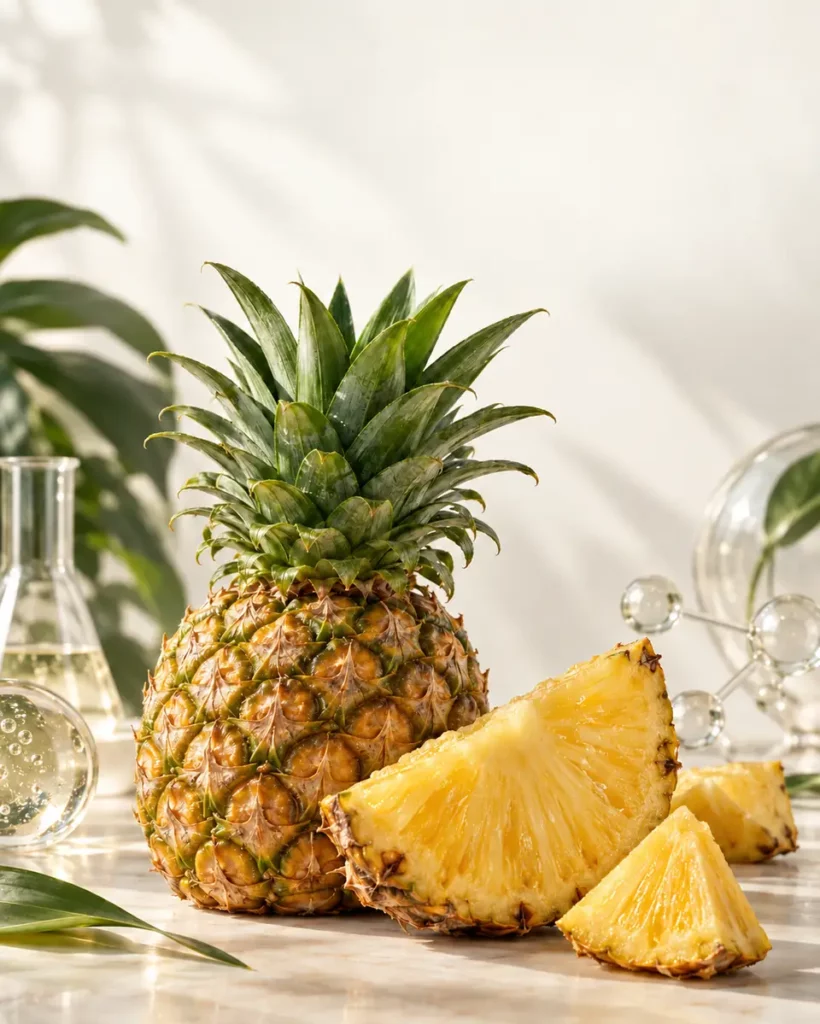
Summary. Bromelain is a mix of protein-digesting enzymes from pineapple, mostly from the stem. People ask about it most in autumn: blocked nose, swelling, “something natural.” It has been studied in sinusitis, pain and post-surgical swelling, and the EU has even approved a bromelain-based medicine for cleaning burn wounds. In Ukraine, bromelain is allowed in dietary supplements, but treatment claims on the label are banned. Here is what research says about it, how to choose a supplement, who should avoid it, and when a blocked nose means it’s time to see a doctor.
The end of September always looks the same at the pharmacy. People come in with their first colds, blocked noses and one question: “Do you have something non-chemical to bring the swelling down?”
Somewhere around the third person, someone always mentions pineapple. A friend took bromelain and it helped.
The friend may well be right. Bromelain is one of the few plant enzymes with a decent evidence base. There is still a long way from “it helped my friend” to “it works for everyone.” Let’s sort it out.

What bromelain is and where it comes from
Bromelain is a mixture of enzymes that break down proteins (proteases, more precisely cysteine proteases). It is extracted from pineapple (Ananas comosus). There are two main types: stem bromelain and fruit bromelain. Supplements and medicines mostly use stem bromelain.
The pineapple industry uses the whole plant here: the fruit goes into cans and juice, and the stems, once thrown away, go into enzyme extraction.
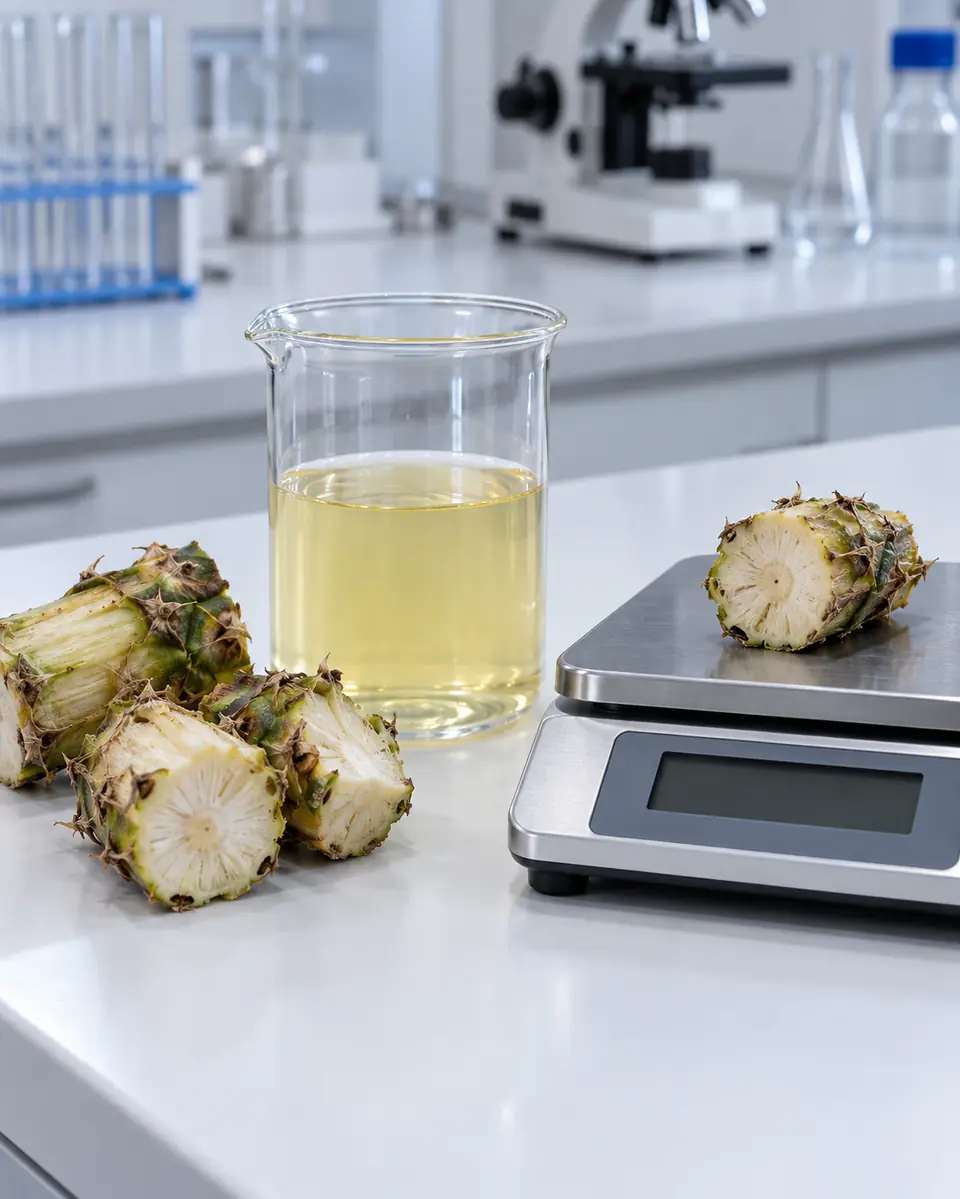
Can you just eat pineapple? Fresh pineapple does contain bromelain, and it’s easy to check: jelly with raw pineapple won’t set because the enzyme breaks down gelatin. Nobody knows how much is in a particular slice, though, and in canned pineapple the enzyme is destroyed by heat. A verified amount needs a standardized product.
One more important point: bromelain strength is measured by activity, not weight. On the pack you may see GDU (gelatin digesting units) or F.I.P. units. Two 500 mg capsules can have very different activity, so the milligram number alone says little.
What bromelain has been studied for, and the results
There is a lot of research on bromelain, more than a hundred clinical studies, but most are small or old. A 2023 systematic review and meta-analysis pooled 54 studies. Its conclusion is cautious: a small but statistically significant effect on pain, benefit in sinusitis, a good effect when applied to wounds, and no major health risks.
Here is the picture by area.
| Area | Available data | What it means in practice |
|---|---|---|
| Acute sinusitis in children | German retrospective study (Braun, 2005): symptoms resolved faster in the bromelain group than with standard therapy | An interesting signal from a weak design. For children, only on a doctor’s decision |
| Chronic rhinosinusitis | Pilot study (Büttner, 2013): 3 months of use, improved symptoms and good tolerability | Small sample, no control group. Larger studies are needed |
| Pain (joints, after injury) | 2023 meta-analysis: a small but statistically significant difference in pain scores | It does not replace painkillers. The effect is modest |
| Swelling after surgery and injury | In Germany, bromelain is registered as a medicine for supportive treatment of swelling, including in the nose and sinuses | There it is a medicine with a label. A supplement in Ukraine cannot carry such indications |
| Burns (topical) | A bromelain-enriched enzyme concentrate (NexoBrid) is approved by the EMA for removing dead tissue in deep burns | The strongest proof of the enzyme’s activity, in a hospital setting, far from capsules |
| Heart and blood vessels | The 2023 meta-analysis found no effect | “Thins the blood” is not a reason to buy it |
How does it work? Part of the bromelain is absorbed from the gut in active form. In lab studies it affects inflammatory mediators (bradykinin, prostaglandins), reduces tissue swelling and makes mucus less thick. That is the logic behind using it for a blocked nose: less swelling of the lining, easier drainage from the sinuses.
To be honest, the mechanism is appealing, and there are no large randomized trials in the common cold. So I would talk about bromelain as possible support, with no promises.
Bromelain and Ukrainian supplement rules
Since April 2026, Ukraine has a closed list of substances allowed in dietary supplements (MoH Order No. 203). Bromelain is on it, as entry 48 in the section on substances with a physiological effect. No maximum daily dose is set for it. Pineapple (Ananas comosus) is also on the plant list, with fruit and stem as permitted parts.
For comparison, some popular enzymes are not on the list at all. We’ll cover serrapeptase and nattokinase separately; they deserve their own article.
Now the label. A dietary supplement may not promise to treat, prevent or cure disease, and may not cite treatment testimonials. Only health claims from the official list are allowed. The EU has not authorized a single health claim for bromelain, so a manufacturer has no legal wording such as “supports nasal breathing.”
See “for sinusitis,” “relieves inflammation” or “treats swelling” on the pack? That is a red flag: either the product is registered as a medicine, or the manufacturer is breaking labeling rules.
How to choose a bromelain supplement

| What to look for | Why |
|---|---|
| Activity in GDU or F.I.P. units | Milligrams without activity don’t tell you how much enzyme is actually working |
| Amount per daily portion | By law, content is stated per recommended daily portion, not per capsule |
| Enteric coating | Some of the enzyme is destroyed in the stomach. An acid-resistant coating helps it reach the gut |
| “Dietary supplement” status and warnings | Mandatory items: do not exceed the portion, does not replace a varied diet, keep away from children |
| A clean formula | Combinations with quercetin or papain are common. Every extra ingredient means extra contraindications |
| Treatment promises | “Treats,” “removes inflammation,” “instead of antibiotics” are banned on supplements. Better to skip such a product |
How to take it? That depends on what you want. Taken with food, bromelain is used up digesting the protein on your plate and works as a digestive enzyme. In studies of its systemic effects, it was given between meals, on an empty stomach. Follow the instructions of the specific product and do not exceed the recommended portion.
Typical supplement doses, according to LiverTox (a US National Institutes of Health database), range from 200 to 2,000 mg per day. LiverTox reports no cases of liver injury linked to bromelain.
Who should avoid bromelain
Please read this part carefully. Natural does not mean safe for everyone.
Allergy. If you are allergic to pineapple, bromelain is not for you. Cross-reactions with papain (the papaya enzyme), latex and some pollen allergens are possible. Reactions range from a rash to anaphylaxis, though they are rare.
Drugs that affect blood clotting. In experiments, bromelain reduces platelet aggregation. If you take warfarin, other anticoagulants, clopidogrel or daily aspirin, talk to your doctor first. Tell your doctor about it before planned surgery or a tooth extraction too.
Antibiotics. Older studies showed bromelain raising blood levels of amoxicillin and tetracycline. This may not be dangerous, but the combination is worth discussing with a doctor.
Pregnancy, breastfeeding, children. There is not enough safety data. Do not take it on your own.
Stomach. The most common side effects are abdominal discomfort, nausea, bloating and sometimes diarrhea. With peptic ulcer disease or gastritis, do not take bromelain without a doctor.
When a blocked nose needs a doctor, not a pharmacy
Most autumn colds are viral and clear up on their own within 7-10 days. The European EPOS 2020 guidelines describe when to suspect bacterial sinusitis and see a doctor:
fever above 38 °C; severe facial pain, especially on one side; pus-like nasal discharge; feeling better and then worse again (“double sickening”); symptoms lasting more than 10 days.
Swelling around the eye, severe headache, double vision or a stiff neck need emergency care. No enzyme will help here.
Frequently asked questions
What is bromelain in simple terms?
Can fresh pineapple replace bromelain?
Is bromelain allowed in dietary supplements in Ukraine?
Should bromelain be taken before or after meals?
Can bromelain be taken with aspirin or anticoagulants?
What do GDU and F.I.P. mean on the label?
Conclusions
Bromelain is one of the best-studied plant enzymes. There is data on benefit in sinusitis, a modest effect on pain, and a serious medical use in burn surgery. In Ukraine it is allowed in dietary supplements with no set maximum dose.
It is still no cure for a runny nose. A supplement cannot promise treatment, and there are no large studies in the common cold. If you decide to try it, choose a product with stated activity, take it as directed, and take your allergies and current medicines into account.
And if your nose has been blocked for more than 10 days, you have a fever or your face hurts, see a doctor first. The pineapple can wait.
📚 References
- Leelakanok N, Petchsomrit A, Janurai T, Saechan C, Sunsandee N. Efficacy and safety of bromelain: A systematic review and meta-analysis. Nutrition and Health. 2023;29(3):479-503. doi:10.1177/02601060231173732
- Braun JM, Schneider B, Beuth HJ. Therapeutic use, efficiency and safety of the proteolytic pineapple enzyme Bromelain-POS in children with acute sinusitis in Germany. In Vivo. 2005;19(2):417-421. PMID: 15796206
- Büttner L, Achilles N, et al. Efficacy and tolerability of bromelain in patients with chronic rhinosinusitis: a pilot study. B-ENT. 2013;9(3):217-225. PMID: 24273953
- Maurer HR. Bromelain: biochemistry, pharmacology and medical use. Cellular and Molecular Life Sciences. 2001;58(9):1234-1245. doi:10.1007/PL00000936
- Pavan R, Jain S, Shraddha, Kumar A. Properties and therapeutic application of bromelain: a review. Biotechnology Research International. 2012;2012:976203. doi:10.1155/2012/976203
- LiverTox: Clinical and Research Information on Drug-Induced Liver Injury. Bromelain. National Institute of Diabetes and Digestive and Kidney Diseases, 2024. ncbi.nlm.nih.gov/books/NBK600584
- Fokkens WJ, Lund VJ, Hopkins C, et al. European Position Paper on Rhinosinusitis and Nasal Polyps 2020. Rhinology. 2020;58(Suppl S29):1-464. doi:10.4193/Rhin20.600
- European Medicines Agency. NexoBrid (concentrate of proteolytic enzymes enriched in bromelain): EPAR. ema.europa.eu/en/medicines/human/EPAR/nexobrid
- Order of the Ministry of Health of Ukraine No. 203 of 19.02.2026 (Annex 3 to the Hygienic Requirements for Dietary Supplements) (in Ukrainian). zakon.rada.gov.ua/laws/show/z0417-26
- Order of the Ministry of Health of Ukraine No. 1145 of 15.05.2020 “On Approval of the Requirements for Nutrition Claims and Health Claims Made on Foods” (in Ukrainian). zakon.rada.gov.ua/laws/show/z0745-20
- European Commission. EU Register of nutrition and health claims made on foods. ec.europa.eu/food/food-feed-portal/screen/health-claims/eu-register
About the Author