Modern Science Verdict:
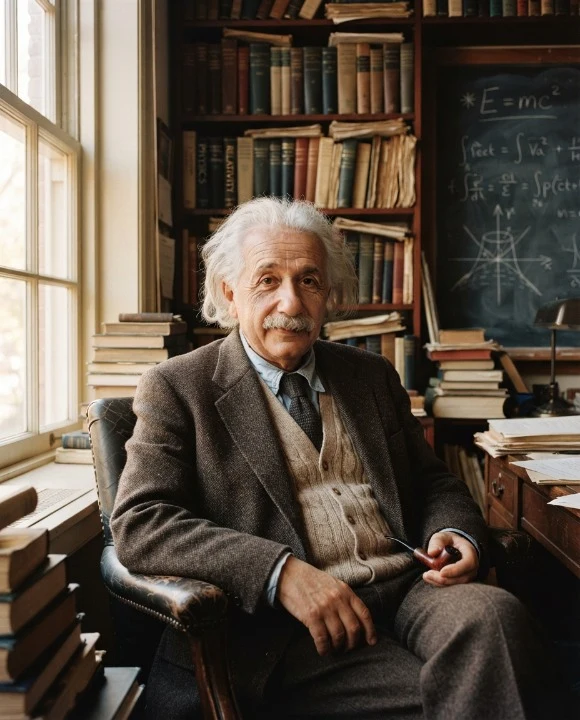
There is no definitive evidence that Albert Einstein had autism or Asperger’s syndrome. Most contemporary neurologists, psychiatrists, and biographers consider this posthumous diagnosis a historical myth. Despite his eccentricities and early childhood speech delay, the physicist possessed robust emotional intelligence, charisma, a rich sense of humor, and formed deep social bonds—traits inconsistent with classic autism spectrum disorder (ASD).
Albert Einstein’s Unusual Childhood: Signs of Autism?
Developmental Delay and Peculiar Behavior
When a child takes a long time to start talking, pediatricians and speech therapists often reassure worried parents with a classic example: “Albert Einstein didn’t speak until he was seven.”
Some historical accounts cite the age of five. Regardless of the exact year, the fact remains: in early childhood, the future Nobel laureate lagged visibly behind his peers in verbal development.
He took his first steps and began speaking long after other children his age were already running around and reciting nursery rhymes.
Until the age of seven, Einstein had a habit of obsessively repeating the same sentence under his breath—this and other eccentricities led family members to wonder whether young Albert was mentally sound.
From time to time, the quiet, solitary boy was overtaken by bouts of intense rage.
During these episodes, his face would turn pale and his nose white, and he struggled to control his actions.
On one occasion, he struck his sister over the head with a wooden toy mallet, and on another, he hurled a chair at his tutor…
Years later, in our century, American researchers retroactively diagnosed him with Asperger’s syndrome—an autism spectrum condition characterized by social communication difficulties, intense fixations, and learning challenges.

Not Autism, but “The Einstein Syndrome”?
In modern pediatrics and psychology, there is even an official term: The Einstein Syndrome. Coined by American researcher Thomas Sowell, it describes the phenomenon where exceptionally gifted children develop speech significantly later than their peers.
Physicians emphasize that late speech does not necessarily indicate intellectual disability or an autism spectrum disorder. In gifted minds, the brain in early childhood often channels immense resources toward analytical, spatial, and musical abilities, temporarily deferring verbal milestones. According to family accounts, young Albert simply found small talk pointless, quietly rehearsing phrases under his breath before saying them out loud.
Strict Maternal Influence and Early Fascination with Science
When Albert was six years old, his strict and overbearing mother, Pauline, enrolled him in violin lessons.
Tedious, repetitive music drills brought little joy to the young boy, but his mother insisted.
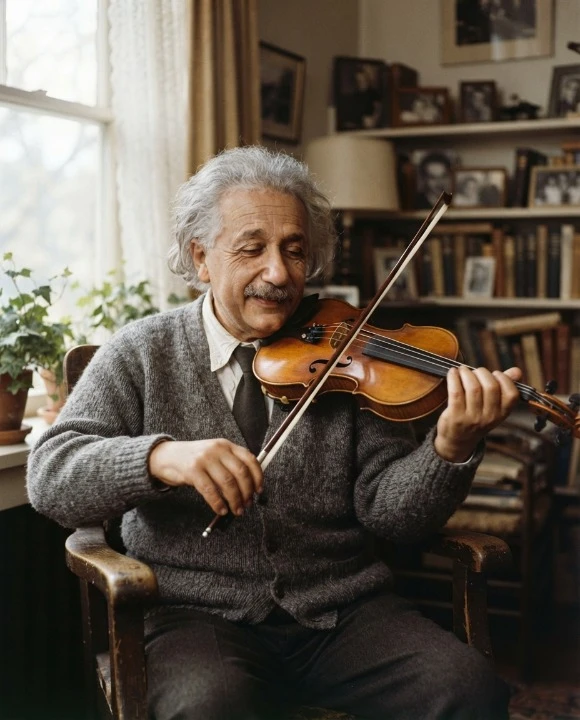
Later in life, Einstein frequently turned to his violin for solace. He even performed in an amateur quintet alongside a mathematician, a police officer, a lawyer, and a bookbinder.
In childhood, however, he practiced purely under compulsion. Biographers suggest that his mother’s overbearing nature and rigid demands may have planted early seeds of resentment toward women in the young physicist’s mind.
Einstein’s Struggles and Triumphs
Health Issues and Early Career Roadblocks
One day, his father Hermann showed him a pocket compass. According to Einstein’s own recollections, this encounter sparked his lifelong fascination with mechanics and the physical world.
Yet in secondary school, young Albert was far from a stellar student. He even failed mathematics, and most of his teachers predicted that nothing worthwhile would ever become of this slow-witted plodder.
He was only admitted to the Federal Polytechnic School in Zurich on his second attempt.
He was rejected from military service due to flat feet and varicose veins, and following his university graduation, his liver failed.
A past bout of hepatitis combined with near-starvation during his post-graduate job hunt severely weakened his health—his job applications were met with one rejection after another. At times, Albert went days without eating.
The relentless stress and adversity triggered a severe stomach ulcer. Fortunately, in 1902, friends helped him secure a clerk position at the Swiss Federal Patent Office in Bern. A year later, at age 24, he married Serbian physicist Mileva Marić.
Marriage to Mileva Marić
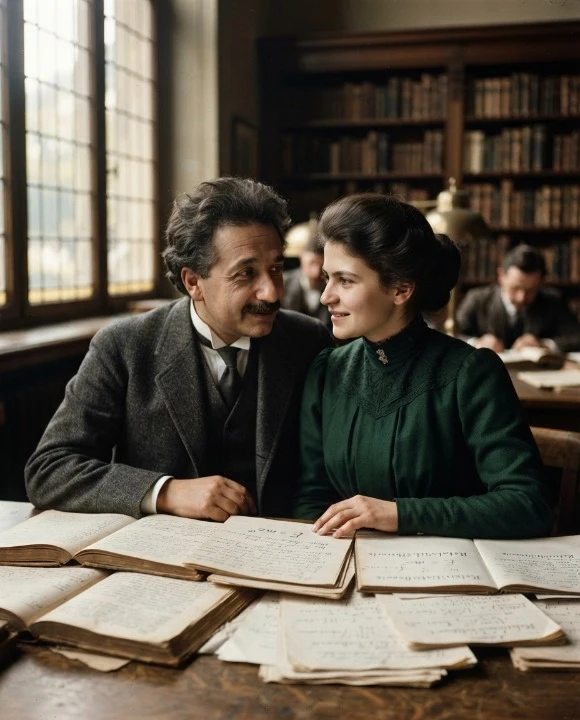
Mileva was the only woman in his physics class. She walked with a limp caused by childhood bone tuberculosis and was far from conventionally glamorous, but possessed a formidable analytical mind and unconventional thinking.
Both sets of parents opposed the marriage. Einstein was told: “Why marry her? She’s lame!” But he countered with a question of his own: “Have you heard her voice?!”
Before their marriage, they had an illegitimate daughter. However, as a condition of marriage, Einstein insisted on relinquishing the child, and Mileva gave the infant up for adoption.
Before finalizing the union, Einstein drafted a rigid domestic pact requiring Mileva to handle all cooking and cleaning, and to leave the room immediately whenever he wished to be alone.
Yet Mileva was far more than a homemaker and mother to their two sons. Einstein’s earliest published papers circulated with both their names, though at some point, her name ceased to appear.
Controversy Surrounding the Theory of Relativity
The Potential Role of Einstein’s Wife
Rumors have long circulated that Mileva Marić was the true mind behind the theory of relativity and that her husband took the credit. Their eldest son, who struggled with schizophrenia in a psychiatric clinic, voiced this claim on multiple occasions.
Skeptics of Einstein’s genius have argued that he possessed ordinary intellect and simply absorbed breakthrough ideas during his years at the patent office. Einstein himself insisted that his only true talent was passionate curiosity.
Additionally, he was a master scientific organizer—some contemporaries described him as an entrepreneur in science.
Even if foundational insights drew on external ideas, he was the first to synthesize, formalize, and publish them into a coherent revolutionary framework—an intellectual feat in its own right.
Nobel Prize for the Photoelectric Effect, Not Relativity
An intriguing historical detail: Albert Einstein was not awarded the Nobel Prize for his groundbreaking theory of relativity, but for his discovery of the law of the photoelectric effect. This occurred in 1921 (awarded in 1922), though he published the breakthrough paper during his “miracle year” of 1905.
Why did the Nobel Committee sidestep relativity? Not because of authorship doubts, but because in the early 1920s, relativity was viewed by conservative academics as too radical, abstract, and lacking definitive experimental verification. To break the deadlock and honor the era’s greatest physicist, the committee selected a more practical and proven discovery—the photoelectric effect.
The prize money—roughly $32,000 at the time—was indeed transferred entirely to Mileva Marić. However, this was not an admission of authorship; it was a binding clause in their 1919 divorce agreement, in which Albert pledged his future Nobel prize funds to support their sons in return for her consent to divorce.
Einstein’s Personality: An Autism Spectrum Disorder?
The “Absent-Minded Professor” Stereotype
TIME magazine famously called Einstein “a cartoonist’s dream come true.”
Indeed, his public persona in later life—dressed in casual oversized sweaters with wild, untamed silver hair—epitomized the quintessential eccentric scientist and “absent-minded professor” archetype in popular culture.
Popular media heavily exaggerated his perceived unworldliness, projecting it onto the broader stereotype of theoretical scientists.
Yet these were largely public caricatures.
Einstein’s Final Days
Refusing Life-Prolonging Surgery
On the afternoon of April 16, 1955, Einstein was resting in his room when his secretary heard him rush to the bathroom and collapse.
A few days earlier, his assistant noticed him wince in pain and asked, “Is everything all right?” Einstein replied: “Everything is fine. But I am not.”
At the hospital, after evaluating his condition, doctors urged him to undergo emergency surgery.
Cause of Death: Ruptured Abdominal Aortic Aneurysm
Modern surgical techniques offered a chance to repair the ruptured artery, but it required the patient’s consent.
Despite severe pain, Einstein adamantly refused surgery: “I want to go when I want. It is tasteless to prolong life artificially.”
He passed away early the next morning, on April 18, 1955.
“The cause of death was a ruptured abdominal aortic aneurysm,” his attending physician Dr. Thomas Bucky confirmed. “And Einstein was right: the autopsy showed that surgery would have been futile, as the rupture occurred too close to the branching renal arteries.”
📚 Scientific Sources and Literature:
- Sowell, Thomas. The Einstein Syndrome: Bright Children Who Talk Late. Basic Books, 2001. (Seminal study on late-talking in exceptionally gifted children without autism).
- Baron-Cohen, S., & Wheelwright, S. Asperger syndrome and high achievement. Journal of the Royal Society of Medicine, 2003. (Cambridge analysis evaluating historical figures against autism spectrum criteria).
- Isaacson, Walter. Einstein: His Life and Universe. Simon & Schuster, 2007. (Definitive biography drawing on personal archives, verifying Einstein’s rich interpersonal and social life).
- American Psychiatric Association (APA). Diagnostic and Statistical Manual of Mental Disorders (DSM-5-TR). (Diagnostic criteria for Autism Spectrum Disorder).
About the Author