-
- Camaschella C. Iron Deficiency. Blood. 2019.
- Cappellini MD, et al. Iron Deficiency Anaemia Revisited. Journal of Internal Medicine. 2020.
- World Health Organization. WHO Guideline on Use of Ferritin Concentrations to Assess Iron Status. 2020.
- Tolkien Z, et al. Ferrous Sulfate Supplementation Causes Significant Gastrointestinal Side Effects. PLoS One. 2015.
- Peeling P, et al. Iron Status and the Athlete. European Journal of Applied Physiology. 2014.
A person starts getting tired faster, finds physical activity more difficult, and complains of weakness, yet the general blood count looks almost normal.
This situation occurs much more often than many might think. In recent years, more and more attention has been paid not only to hemoglobin but also to ferritin — a protein that reflects the body’s iron stores. It is low ferritin that often causes complaints long before the development of classic iron-deficiency anemia. If you are already facing this issue, we recommend checking out our guide on how to raise iron levels in the body.

Why Ferritin is Being Talked About More Often
Twenty years ago, most people only knew about hemoglobin.
It was the standard indicator traditionally checked when anemia was suspected.
Today, doctors are increasingly focusing on ferritin.
The reason is simple.
Hemoglobin shows the current situation with oxygen transport.
Ferritin reflects the iron stores in the body.
Sometimes stores are already being depleted, while hemoglobin remains within the normal range.
It is during this period that the first symptoms may appear.
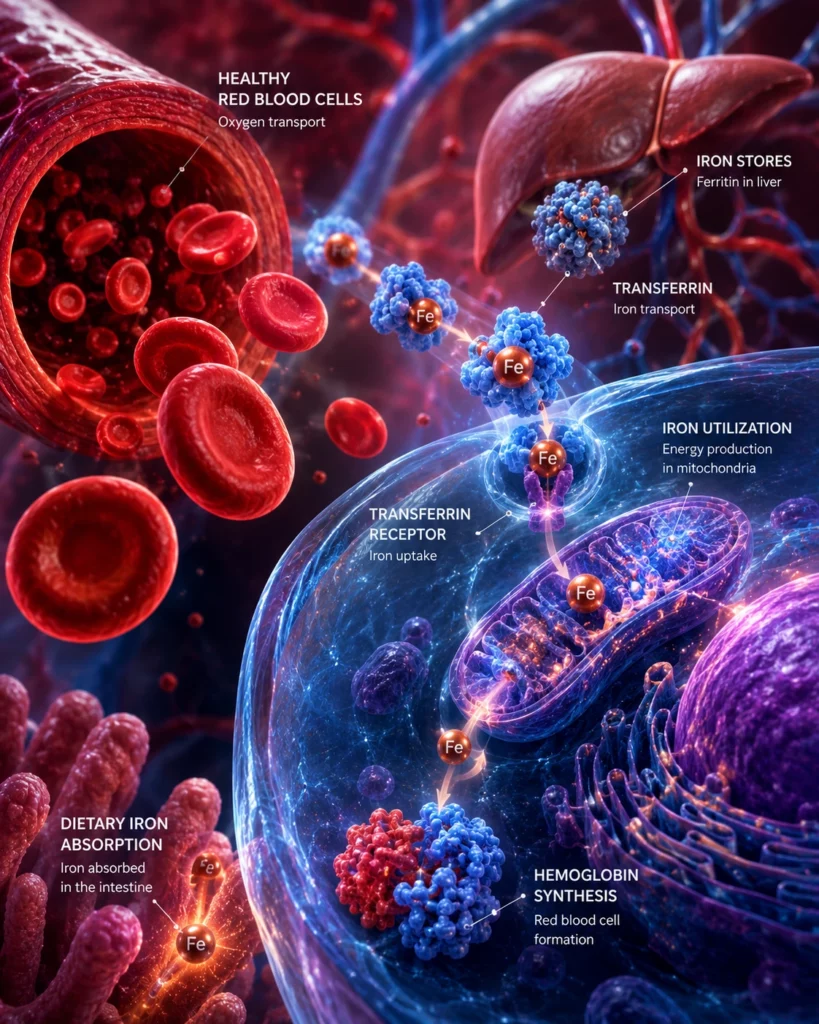
What is Ferritin in Simple Terms
If you imagine the body as a large company, iron would be a strategic raw material.
In this case, ferritin plays the role of a warehouse.
When the body needs iron, it takes it from these stores.
If the warehouse becomes empty, problems arise.
That is why a ferritin test allows for the assessment of iron reserves even before visible anemia appears.
Why the Body Needs Iron
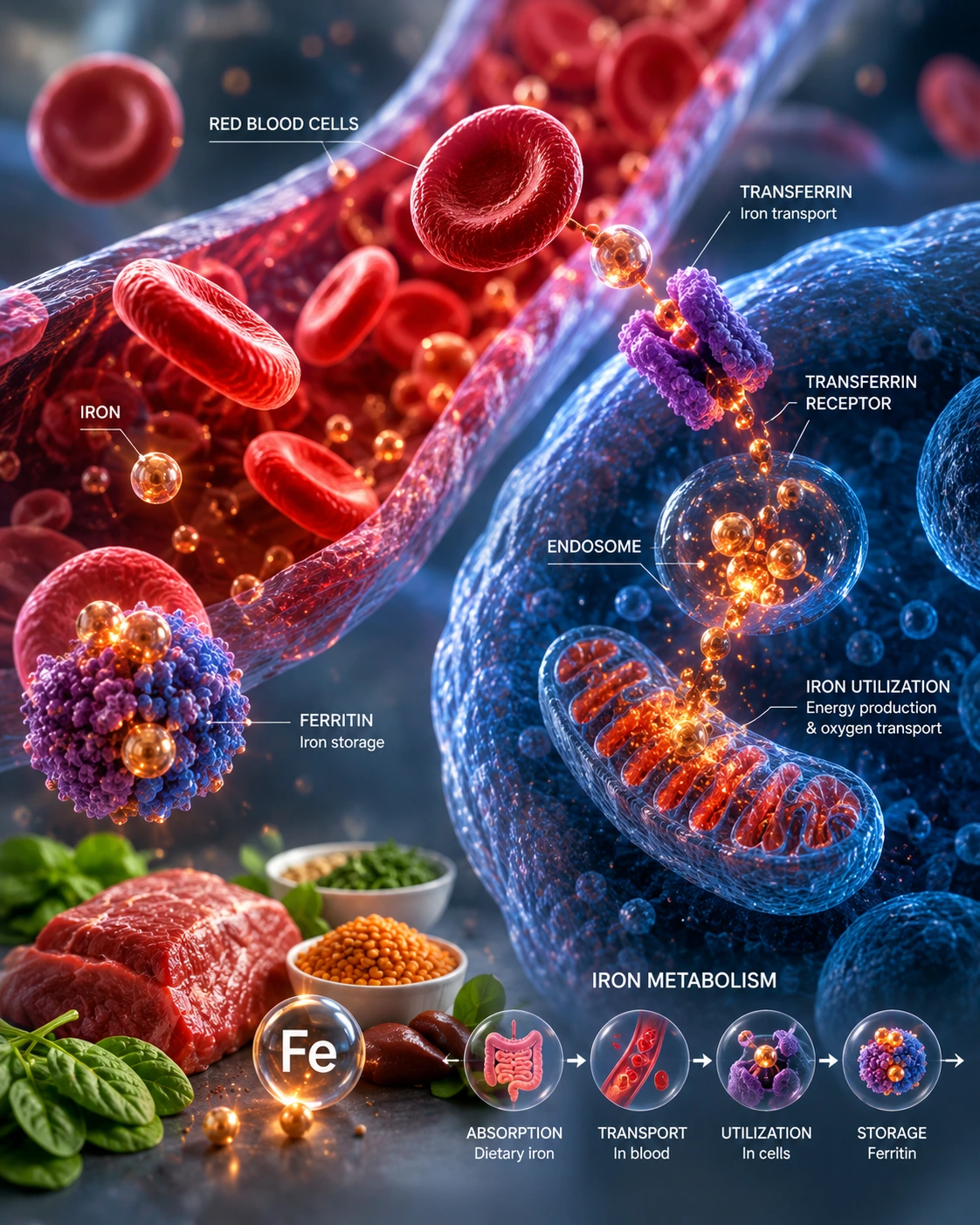
Most people associate iron exclusively with blood.
In reality, its functions are much broader.
Iron participates in:
- oxygen transport;
- muscle function;
- energy production;
- functioning of the nervous system;
- immune cell activity;
- many enzymatic processes.
Therefore, iron deficiency can affect various systems of the body.
Why Ferritin Levels Might Decrease
There are many reasons.
Sometimes the problem lies in insufficient iron intake from food.
In other cases, the situation is much more complex.
The most common factors include:
- heavy menstruation;
- pregnancy;
- restrictive diets;
- intestinal diseases;
- malabsorption;
- regular blood loss;
- intense athletic training.
That is why finding the cause is just as important as identifying the deficiency itself.
Symptoms of Low Ferritin
One reason for the popularity of this topic is that the symptoms are very non-specific.
Many people attribute them to stress or fatigue for years.
The most common ones include:
- chronic fatigue;
- decreased endurance;
- sleepiness;
- impaired concentration;
- hair loss;
- brittle nails;
- reduced productivity.
The problem is that such complaints can have dozens of different causes.
Does Low Ferritin Always Mean Anemia?
No.
And this is exactly what often causes confusion.
A person may have:
- normal hemoglobin;
- normal red blood cell count;
- low ferritin.
This condition is sometimes called hidden (latent) iron deficiency or depletion of iron stores.
This has been the subject of a large amount of research in recent years.
Table 1. Differences Between Hemoglobin and Ferritin
| Indicator | What it Reflects |
|---|---|
| Hemoglobin | Oxygen transport by blood |
| Ferritin | Iron stores in the body |
| Serum Iron | Current level of iron in the blood |
| Transferrin | Iron transport |
| Transferrin Saturation | The body’s iron supply status |
Why Low Ferritin Doesn’t Always Mean Iron Deficiency
There is another important nuance.
Ferritin is one of the acute-phase inflammatory proteins.
Its level can increase during:
- infections;
- chronic inflammatory processes;
- certain liver diseases;
- metabolic disorders.
Therefore, the result must be interpreted in the context of the overall clinical picture.
A single test does not always provide a complete answer.
Why Women Experience Iron Deficiency More Often
The statistics here are quite clear.
Women of reproductive age are in a high-risk group.
The main reasons include:
- regular blood loss during menstruation;
- pregnancy;
- breastfeeding;
- increased iron requirements.
This is why the topic of ferritin is especially frequently discussed among women aged 20 to 45.
Hair Loss and Ferritin: Is There a Link?
This is one of the most popular topics on social media.
Indeed, low iron stores can be associated with hair loss.
But the problem is much more complex.
Hair health is also influenced by:
- genetics;
- hormonal balance;
- nutrition;
- stress;
- thyroid diseases.
Thus, ferritin is only one of many factors, not a universal explanation for all hair-related issues.
Why Athletes Increasingly Monitor Ferritin
Iron requirements can change during intensive training.
This especially applies to:
- long-distance runners;
- cyclists;
- triathletes;
- professional athletes.
Depletion of iron stores can impact endurance and athletic performance.
That is why sports medicine is paying more and more attention to this indicator.
Table 2. Groups Most Frequently at Risk for Iron Deficiency
| Group | Reason |
|---|---|
| Women of reproductive age | Regular blood loss |
| Pregnant women | Increased body requirements |
| Vegetarians and vegans | Dietary specifics |
| Endurance athletes | High physical loads |
| People with intestinal diseases | Absorption disorders |
| Teenagers | Active growth |
Most Common Myths About Ferritin
If hemoglobin is normal, there are no issues with iron
Not always.
Iron stores can drop even before hemoglobin changes occur.
Any fatigue means iron deficiency
No.
There are very many causes of chronic fatigue.
The higher the ferritin, the better
This statement is incorrect.
Excessively high values also require professional evaluation.
Iron deficiency only occurs in women
No.
Men can also encounter this problem.
Questions and Answers
How does ferritin differ from hemoglobin?
Ferritin shows iron stores, whereas hemoglobin reflects its role in oxygen transport.
Can ferritin be low when hemoglobin is normal?
Yes. This is a fairly common situation.
Is ferritin related to hair loss?
Such a link may exist, but it is not the sole cause of the problem.
Why do athletes monitor ferritin?
Because of the potential impact of iron stores on endurance and recovery.
Can iron stores be assessed by hemoglobin alone?
No. A complex set of indicators is used for this purpose.
Conclusions
It is no accident that ferritin has become one of the most discussed laboratory indicators in recent years. It allows for an evaluation of iron stores in the body and can help identify a problem before classic anemia develops.
That is why the modern approach to assessing iron-deficiency states is increasingly rarely limited to a general blood count alone. Sometimes the answer to the question of constant fatigue is hidden not in hemoglobin, but specifically in depleted iron stores.
References
-
- Camaschella C. Iron Deficiency. Blood. 2019.
- Cappellini MD, et al. Iron Deficiency Anaemia Revisited. Journal of Internal Medicine. 2020.
- World Health Organization. WHO Guideline on Use of Ferritin Concentrations to Assess Iron Status. 2020.
- Tolkien Z, et al. Ferrous Sulfate Supplementation Causes Significant Gastrointestinal Side Effects. PLoS One. 2015.
- Peeling P, et al. Iron Status and the Athlete. European Journal of Applied Physiology. 2014.
About the Author