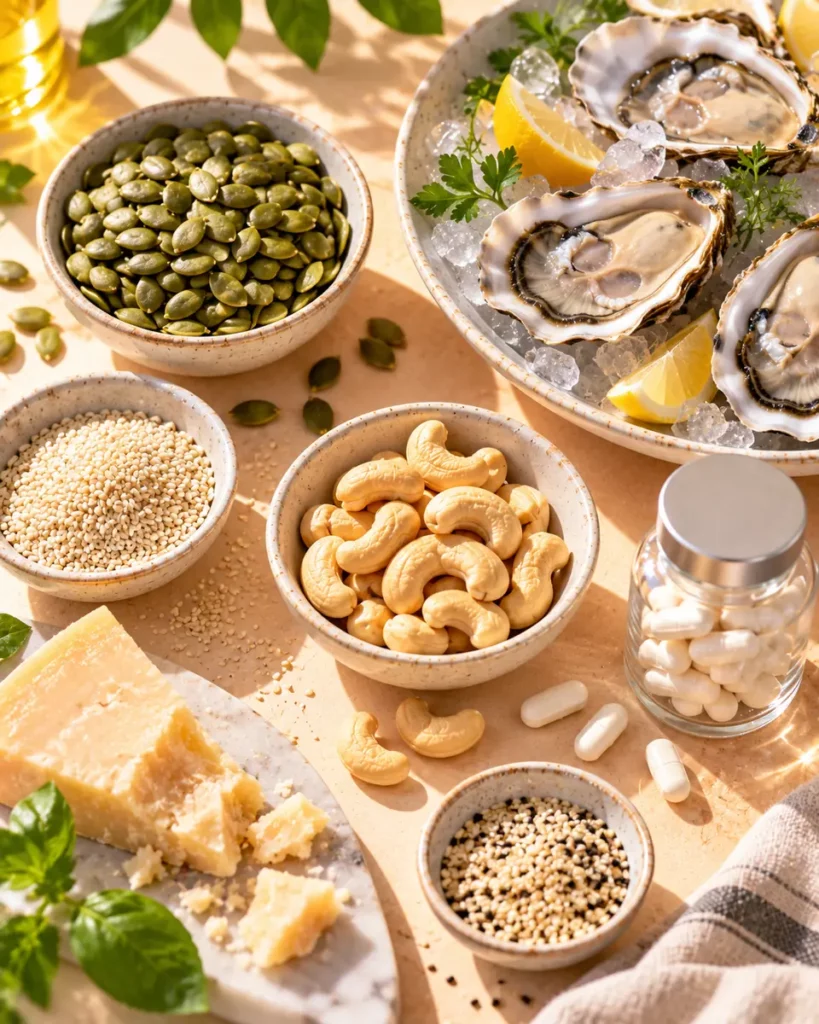
The short version. Adults need roughly 8-16 mg of zinc a day, and the exact figure depends on how much bread, cereals and legumes you eat. The richest sources are oysters, beef, pumpkin seeds and hard cheese. Zinc will not protect you from colds, but it may shorten one slightly if you start early. Here is who is at risk of deficiency, which form to choose, how not to overdo it, and why zinc does not get along with iron and copper.
In autumn, people ask for zinc at the pharmacy almost as often as vitamin C. “For immunity”, “for colds”, “for my hair”, “for acne”. Zinc really matters, but a supplement does less than the ads promise. And too much of it has unpleasant side effects that usually sit in the small print.
Below I explain who really needs zinc and who will do fine with ordinary food.
What zinc does and how much you need
Zinc works inside hundreds of enzymes. Without it the immune system works worse, wounds heal more slowly, skin and hair suffer, and taste and smell fade. It is needed for protein and DNA synthesis, children’s growth, insulin and sex hormones.
One important detail: the body cannot store zinc the way it stores iron or vitamin D. So zinc has to come from food every day.
Now for the daily need, and this part is interesting. The European Food Safety Authority set it depending on how much phytate your diet contains. Phytates come from whole-grain bread, cereals, legumes and nuts, and they bind zinc so it is absorbed less. So men need 9.4 to 16.3 mg a day and women 7.5 to 12.7 mg. The lower figure fits a diet with meat and white bread, the higher one fits someone who eats a lot of grains and beans. The US recommendation is simpler: 11 mg for men and 8 mg for women.
| Food | Zinc, mg per 100 g | How well it is absorbed |
|---|---|---|
| Oysters | about 17-40 | Very well, the record holder among foods |
| Beef (cooked, stewed) | about 6-8 | Well, animal protein helps absorption |
| Pumpkin seeds | about 7.8 | Moderately, phytates interfere |
| Sesame seeds | about 7.8 | Moderately, phytates interfere |
| Cashews | about 5.8 | Moderately |
| Hard cheese | about 3-4 | Well |
| Oats (dry) | about 3.6 | Less well due to phytates |
| Turkey, chicken thigh | about 2.5-3 | Well |
| Buckwheat (dry groats) | about 2.4 | Less well due to phytates |
| Chickpeas (cooked) | about 1.5 | Less well, soaking helps |
| Egg | about 1.3 | Well |
Figures are rounded, based on USDA FoodData Central. A tip for bean lovers: soak them overnight and choose sourdough bread. That lowers phytates and helps zinc absorption.

Signs of zinc deficiency and who is at risk
Mild zinc deficiency has no single obvious symptom. But there is a cluster worth noticing: frequent colds, scratches that take weeks to heal, hair loss, brittle nails, dry skin and rashes, food tasting odd or a weaker sense of smell. In children, also slowed growth and poor appetite.
A blood test for zinc exists, but it is imprecise: serum levels shift during the day, after meals and with inflammation. So doctors usually look at the whole picture: diet, symptoms, tests.
Who is more often low in zinc? Vegetarians and especially vegans: US guidance suggests they may need up to 50% more zinc than the usual recommendation. Pregnant and breastfeeding women. Older adults. People with Crohn’s disease, celiac disease or after stomach surgery. Regular drinkers. And people on long-term thiazide diuretics, which increase zinc losses in urine.

Zinc for colds: what the research shows
A new Cochrane review came out in 2024: 34 trials with more than 8,500 participants. Here is what it found.
Prevention. Taking zinc regularly to avoid getting sick barely changes the risk of a cold. So “zinc all autumn for immunity” does nothing for a healthy person without a deficiency.
Treatment. Starting zinc in the first hours of illness may shorten a cold by about 2 days. But the authors rated the evidence as low quality, and side effects like a metallic taste and nausea were more common than with placebo.
The best results came from zinc acetate or gluconate lozenges dissolved in the mouth every 2-3 hours during the first 24 hours of a cold. The idea is for zinc to act right in the throat, so a regular tablet you simply swallow does not work the same way.
One important warning: zinc nasal sprays and gels. They have been linked to long-lasting, sometimes permanent loss of smell. Best to skip them.
If you have read our article on vitamin C for colds, you will notice the same pattern: regular adequate intake helps, while last-minute “mega doses” are overrated.

Zinc for skin, hair and acne
Acne. Here zinc has real data behind it. A 2020 meta-analysis found that people with acne have lower blood zinc on average, and zinc supplements reduced the number of inflamed spots. In a French trial zinc worked less well than the antibiotic minocycline, but it still helped. So zinc is a helper alongside dermatologist treatment and cannot replace it.
Hair. Zinc deficiency can indeed cause hair loss. But if you get enough zinc, extra tablets will not make your hair thicker. Check iron, ferritin, thyroid and vitamin D first.
Wounds and skin. With zinc deficiency, wounds heal more slowly, and correcting it helps. Zinc also appears in many creams and pastes, such as zinc oxide for diaper rash, but that is a different story.
Which zinc is best: supplement forms
Like magnesium, zinc in supplements always comes as a salt. Labels also often list the weight of the whole salt. The zinc itself is much less. For example, “zinc gluconate 70 mg” contains only about 10 mg of elemental zinc.
Unlike magnesium, the differences between zinc forms are not that big. In a 2014 study by Wegmüller and colleagues, citrate and gluconate were absorbed equally, about 61% of the dose, while oxide did a bit worse at around 50%.
| Form | Elemental zinc, approx. | Absorption | Notes |
|---|---|---|---|
| Gluconate | 14% | Good | The most common, often in lozenges |
| Citrate | 31% | Good | Less bitter, a good basic option |
| Acetate | 30% | Good | Best data for cold lozenges |
| Bisglycinate (chelate) | about 25% | Good | Gentler on the stomach |
| Picolinate | about 20% | Good | Popular, but no proven advantage over citrate |
| Sulfate | about 23% | Good | More likely to upset the stomach |
| Oxide | about 80% | Slightly lower | Cheap, common in multivitamins |
All these forms are permitted in dietary supplements in Ukraine under Order No. 1114, and vitamin and mineral content on labels is now given per recommended daily serving, as we explained in our article on Order No. 203. The label reference value for zinc in the EU and Ukraine is 10 mg.

How to take zinc properly
Dose. For general support with a less-than-perfect diet, 5-15 mg of elemental zinc a day is usually enough. EFSA set a safe upper limit of 25 mg a day for adults from all sources, US experts 40 mg. Higher doses to treat deficiency are prescribed by a doctor for a limited time.
Timing. Zinc absorbs better on an empty stomach but often causes nausea. If so, take it with a meal. Don’t wash it down with milk or pair it with bran porridge, since calcium and phytates reduce absorption.
Zinc and iron. They compete for absorption. If you are raising iron and ferritin with supplements of 25 mg or more, take zinc at a different time of day. Small amounts in multivitamins don’t interfere much.
Zinc and copper. This is the main risk labels stay quiet about. Taking 50 mg of zinc or more daily for a long time blocks copper absorption. The result can be anemia, weaker immunity and, in severe cases, numbness and walking problems. So “a three-month course of 50 mg zinc for hair” without a doctor is a bad plan.
Medicines. Take tetracycline and fluoroquinolone antibiotics at least 2 hours before or 4-6 hours after zinc. Keep penicillamine at least an hour apart from zinc. Thiazide diuretics increase zinc losses.
Zinc and magnesium. They are often sold together, and that is a fine combination. We covered how to take magnesium in a separate article.
What is a label actually allowed to claim? In the EU, approved claims for zinc include “contributes to the normal function of the immune system” and “contributes to the maintenance of normal skin, hair and nails”. Claims like “cures colds” or “clears acne” go beyond the rules for food supplements.
Frequently asked questions
What is zinc good for?
How much zinc do I need a day?
What are the signs of zinc deficiency?
Does zinc help with colds?
When is the best time to take zinc?
Can I take zinc long term?
Which form of zinc is absorbed best?
Conclusions
Adults need roughly 8-16 mg of zinc a day. Meat, seafood, cheese, pumpkin seeds and nuts cover this easily, while vegetarians should pay more attention to zinc.
Zinc does not prevent colds, but lozenges in the first hours of illness may shorten one slightly. For acne it can help, and for hair it only helps if you are deficient.
If you need a supplement, choose citrate, gluconate or bisglycinate at 5-15 mg of elemental zinc, don’t go over 25 mg a day without a doctor, and space zinc from iron and antibiotics.
📚 References
- EFSA NDA Panel. Scientific Opinion on Dietary Reference Values for zinc. EFSA Journal. 2014;12(10):3844. doi:10.2903/j.efsa.2014.3844
- EFSA Scientific Committee on Food, Scientific Panel on Dietetic Products, Nutrition and Allergies. Tolerable Upper Intake Levels for Vitamins and Minerals. EFSA; 2006. efsa.europa.eu
- NIH Office of Dietary Supplements. Zinc: Fact Sheet for Health Professionals. ods.od.nih.gov
- Nault D, Machingo TA, Shipper AG, et al. Zinc for prevention and treatment of the common cold. Cochrane Database Syst Rev. 2024;5:CD014914. doi:10.1002/14651858.CD014914.pub2
- Hemilä H. Zinc lozenges and the common cold: a meta-analysis comparing zinc acetate and zinc gluconate, and the role of zinc dosage. JRSM Open. 2017;8(5):2054270417694291. doi:10.1177/2054270417694291
- Wegmüller R, Tay F, Zeder C, Brnić M, Hurrell RF. Zinc absorption by young adults from supplemental zinc citrate is comparable with that from zinc gluconate and higher than from zinc oxide. J Nutr. 2014;144(2):132-136. doi:10.3945/jn.113.181487
- Yee BE, Richards P, Sui JY, Marsch AF. Serum zinc levels and efficacy of zinc treatment in acne vulgaris: A systematic review and meta-analysis. Dermatol Ther. 2020;33(6):e14252. doi:10.1111/dth.14252
- Dréno B, Moyse D, Alirezai M, et al. Multicenter randomized comparative double-blind controlled clinical trial of the safety and efficacy of zinc gluconate versus minocycline hydrochloride in the treatment of inflammatory acne vulgaris. Dermatology. 2001;203(2):135-140. PubMed 11586012
- USDA FoodData Central. fdc.nal.usda.gov
- Commission Regulation (EU) No 432/2012 establishing a list of permitted health claims made on foods. EUR-Lex
- Order of the Ministry of Health of Ukraine No. 1114 of 19.12.2013 “On Approval of Hygienic Requirements for Dietary Supplements”. zakon.rada.gov.ua/laws/show/z2231-13
- Order of the Ministry of Health of Ukraine No. 203 of 19.02.2026, registered with the Ministry of Justice on 30.03.2026 under No. 417/45811. zakon.rada.gov.ua/laws/show/z0417-26
About the Author